Friday, October 06, 2006

In and around the NYFF


The first two weeks of October are always one of the busiest times of the year for me. There's work deadlines. The New York Film Festival. The theater season. The new TV season. Vacuuming. Personal stuff. All of which conspires to keep me from blogging just when I should really be working the keyboard.

But I would be lax in my duties not to say at least a little something about the films I've been seeing in and around the festival, though it can only be a little something for now. As most of the movies are sold out at Lincoln Center, I can always return to them closer to their release.

Right? Or just rationalizing?

Anyway...playing at the festival this weekend...briefly noted...

Volver (Sony Pictures Classics, opens Nov. 3). After the chilly intellectual breezes of Talk to Her and Bad Education, Pedro Almodovar's new film warms the circulation. The subject matter--hauntings, cancer, severely dysfunctional family relationships, homicide--is bleak but the filmmaker has calibrated everything to the strut and bounce of Penelope Cruz's ravishing performance. Wearing a big caboose as if she were born to it, her liberation from stultifying U.S. roles is worth the price of admission, with the great Carmen Maura and a cast of fine actresses adding to a smart, reflective entertainment.

The Host (Magnolia Pictures; opens January 2007). Little Miss Sunshine meets Godzilla. When a ravening monster makes off with a plucky schoolgirl, her family is forced to put their grudges and anxieties behind as Korean bureaucracy and American duplicity prove as much of a challenge as the creature, a tadpole-like beast with a prehensile tail and the ever-devouring mouth of Little Shop of Horrors' Audrey II. Bong Joon-ho made one of my favorite films of recent years, Memories of Murder, and his contribution to monsterdom is an equally impressive mixture of satire, social criticism, and gentle humanism. A remarkable balancing act.

David Lynch's Inland Empire and Johnnie To's Triad Election (plus a peek at the Hong Kong filmmaker's very latest, Exiled) are on the slate for Sunday.

Screening next weekend at the festival is Emmanuel Bourdieu's unsettling Poison Friends (Strand Releasing), about a very particular type we all come across, this time at university in Paris--an effortlessly charismatic know-it-all (newcomer Thibault Vincon as Andre) whose effect on those in his orbit is part galvanizing and part paralyzing, inspiring, intimidating, and undermining all at once. The strength of the piece is that it refuses to outright condemn Andre, who is more, and less, what he seems to be through the prism of his merciless ego. The accompanying short, Chronicle of a Leap, is a delight, by the way.

The closing film, Guillermo del Toro's Pan's Labyrinth (Picturehouse, opens Dec. 29, and pictured), is very much a case of saving the best for last. A sweeping fantasy of a little girl caught in the crossfire of Franco-era fascism and insurgent resistance fighters in 1944 Spain, it takes its place with the best films of its kind, like Forbidden Games, The Night of the Hunter, and The Spirit of the Beehive, but is very much one-of-a-kind, a great leap forward for the inventive but inconsistent maker of The Devil's Backbone and Hellboy. Sergi Lopez is wonderfully malevolent as a sadistic captain, right up there with Robert Mitchum in Hunter, and Ivana Baquero charming as his youngest, most unexpected opponent. The fantasy aspects, creepy and persuasively design, augment the storyline well. Terrific.

Two other films open next weekend. Douglas McGrath's Infamous (Warner Independent Pictures) plows the same ground as last year's Capote, but with a lighter, "gayer" touch, as the writer (dead ringer Toby Jones) more explicitly finds a kinship with his journalistic quarry, the In Cold Blood killer Perry Smith (Daniel Craig). The New York material is mostly new and the all-star cast largely pleasant company, but once the film hits Kansas it's scene-to-scene similar to its more sober predecessor. Being first has definite advantages.

Being way, way out there does not, as is the case of Terry Gilliam's Tideland (ThinkFilm). This is an unfathomable and only very intermittently watchable story about a little girl lost in her own imagination of broken dolls and friendless souls once her hard-rocking father (Jeff Bridges) dies of a drug overdose, leaving behind little more than his rotting corpse in their isolated farmhouse home. Like David Cronenberg's Spider, the running time is largely given over to the kid (Jodelle Ferland in a heroically untethered performance) babbling nonsense to herself, a sure way to clear a theater. Those of us who stayed behind to watch to the bitter end were rewarded with an impressively staged aftermath of a train wreck, a metaphor that suits the entire artfully botched film. Only the hardest-core Gilliamites need apply; the rest of us can only hope that his semi-serious begging for work leads next time to a more engaging movie.

I hear the vacuum cleaner calling my name...

Tuesday, October 03, 2006

NYFF: Remembering Reds


In advance of its DVD debut next week, from Paramount Home Video, the New York Film Festival is screening Warren Beatty's Reds tomorrow evening. To further commemorate its 25th anniversary, the Village East theater in Manhattan is playing the film for a week, beginning this Friday.

Pretty middlebrow for the festival as it is today--hard to believe but in 1981 the NYFF got away with showing that year's eventual, and inferior, Best Picture winner, Chariots of Fire, which would be hooted off the screen if it were to be revived--and soapy and "Hollywood" in sections, the "interesting but wildly overpraised" (Leonard Maltin) Reds is still worth revisiting. Following up the audience-friendly Heaven Can Wait (1978) with a costly 200-minute drama about early 20th century radicalism and Bolshevism took fire in the belly for Beatty, a spark that has only flickered in subsequent features (I'd say the big problem with the much-scorned Ishtar is that, with the passing of time, it's a minor, throwaway disappointment, and not a major flop a cult can rally behind, like Heaven's Gate--one Columbia will assuredly not be celebrating on its 20th anniversary next year). The movie, framed with its novel use of elderly historical "witnesses" to comment on the tale, looks back wistfully on idealism and broken dreams; I suspect the supplement-laden DVD, a form Beatty has only just embraced, will have the same effect on viewers, taking us back to a Hollywood yesteryear when a Reds could buck the corporate system and get made.

My mom took me and one of my friends to see Reds when it played at the defunct Rockaway Townsquare Mall cinemas in New Jersey, in early 1982. Given that it bogs down in fiery speeches from time to time, and is short on physical action (big movies still get made, just not quiet, more intellectually challenging ones) it didn't have the same effect on my teenage consciousness as did, say, Raging Bull or Dressed to Kill, which mom also took me to see. But it made me want to know more about its subjects and personalities, and when a walking tour last year took me past John Reed's old haunts in Greenwich Village I could once again hear Diane Keaton's Louise Bryant warbling "I Don't Want to Play in Your Yard." I carried that tune around in my head for years after seeing the film (once at the theater, several times, if only in parts, on cable), and it was nice to have it pop back into my memory bank. Beatty, Keaton, Jack Nicholson (as a gimlet-eyed Eugene O'Neill) and Maureen Stapleton (an Oscar winner as the feisty Emma Goldman) are all aces (the last cast to be Oscar-nominated in all four acting categories) and I'm sure time has not dimmed the lustrous, Oscar-winning images DP Vittorio Storaro summoned for Beatty, who also claimed a statuette for his direction.

"It's rather a sad movie, because it really isn't very good," sniffed Pauline Kael, a Reds-baiter. But it's rather good enough. I'd go with David Thomson: "Still a fascinating picture with passages of greatness."

Monday, October 02, 2006

Naughty but nice


Shortbus begin exhilaratingly. A gorgeous diorama of New York City is unveiled. The nimble camera of cinematic Frank G. Demark glides up and around its talkie avenues, then pops in and out of windows, alighting on couples engaged in various forms of afternoon delight. Overlooking ground zero, a dominatrix cracks the whip over her "trust-fund baby" client. ("If you could be a superhero, what kind of superpower would you have?" he asks. "The power to make you more interesting," she responds. Crack!) A young gay man idly takes pictures of himself, then indulges in an impressive act of "self help" before his lover arrives to lend a hand, while a voyeur watches intently from a neighboring window. A sex therapist (played by Canadian TV personality Soon-Yik Lee, pictured) makes athletic but underwhelming whoopee with her husband, her only partner--to date.

The second film from Hedwig and the Angry Inch creator John Cameron Mitchell, Shortbus (opening Oct. 4, from ThinkFilm) is sweet and silly. The therapist, Sofia, confides in the gay couple, who have come to her for treatment, that she has never reached orgasm. (This after slapping them around. Sofia evidently trained at the same institute where Genevieve Bujold's frustrated radio shrink Nancy Love, in Alan Rudolph's Choose Me, got her degree. The films share a slightly similar vibe.) They recommend she joins them at a "shortbus," a polysexual party where anything goes, and where all the film's characters converge, intersect, and break apart, forming new relationships and/or reenergizing the existing ones.

The converging, intersection, and breaking apart is quite literal. As we saw in the opening sequence, which climaxes rather than concludes, nothing if left to the imagination in this unrated film. Mitchell's simple, but radical, idea, is to reclaim pleasure from pornography. The sex, which in most porn looks like pile-driving, is humanized here, even at its most unconventional (a gay threesome whose participants simultaneously start singing "The Star-Spangled Banner" is funny, rather than tasteless, or heavily ironic). There are "money shots" but the camera is largely positioned at a curious, let's-see-what-we-have-here middle distance. The mostly non-professional actors (with a smattering of downtown types, like ringmaster Justin Bond, among them), who helped Mitchell devise the script, are never violated for our jollies. Provided you can handle sex scenes that may veer from your comfort zone, Shortbus is an upbeat and disarming experience, with another langorous Yo La Tengo score to accompany a utopian vision far different than the one depicted in Old Joy.

Shortbus is also a thoroughly enjoyable Manhattan movie, moving from its allusion to 9/11 to the peace and quiet of the 2003 blackout, a bliss-out that settles over the film. I left satisfied.

Sunday, October 01, 2006

Angel in America


At age 50, playwright and liberal activist Tony Kushner is a little young for documentary treatment--but if the likes of Jessica Simpson can snag an hour on E! for their accomplishments, I can't begrudge an hour-and-a-half in the company of one of America's finest authors. As it happens, seeing both parts of his epic "fantasia" Angels in America, which I caught on a Wednesday matinee and evening toward the end of its Broadway run in 1994, is one of the best experiences I have ever had in my life. Note that I didn't add the qualifier "theatrical" before "experiences"--it was this monumental production, so full of life and art and anger and love and showbiz, that really got me interested in the theater, and that really made me think about the many issues it enveloped, and I can truly say I emerged a better (or at least, more thoughtful) person from having seen it.

Freida Lee Mock's unashamedly admiring Wrestling With Angels: Playwright Tony Kushner, which opens Oct. 4 at Manhattan's Film Forum, was filmed about a decade after this breakthrough, and offers a picture of the writer juggling various projects from just after 9/11 to the 2004 presidential election. Mock, an Oscar winner for Maya Lin: A Strong Clear Vision, typically captures Kushner in mid-stride, hurdling from his Union Square office or upstate New York home to attend to, among others, his play Homebody/Kabul; Mike Nichols' very fine HBO film of Angels in America (the photo shows him, center, visiting its Central Park location); an adaptation of Brundibar, a children's opera designed by Maurice Sendak, and based on a production the youngest victims of the Holocaust performed in captivity; and the musical Caroline, or Change, which encompasses some of his boyhood in Louisiana.

Personal recollections are fleeting. We hear a little about his troubled relationship with his musician father, a rift, caused by Kushner's homosexuality, that healed. We see his wedding ceremony to his life partner, but hear nothing from either man about what they mean to each other. Kushner has a lot of barbed, funny, and generous things to say about the U.S. political scene and the many issues addressed in his work, but is largely discreet about himself. This is one portrait that lacks an animating brushstroke, the stuff of life to make it more fascinating on the celluloid canvas. (There is his weight fluctuation, which rises and falls from scene to scene and is attended to by his "fat doctor,", but what I wanted was more of his inner life.)

In an interview in today's New York Times, Kushner quite rightly laments the absence of critical voices in the film. Mock's lame response is that no controversies arose during the filming. No go. For openers, Mock might have sat down with Times reviewer Ben Brantley, whose appraisal of Caroline, or Change, a Broadway flop after its mixed reception off Broadway at the Public, was withering (and close to my own opinion). All we get is the good news from Frank Rich, and everyone else; surely a member of the right could have been found as a rebuttal witness?

The inescapable flaw with Wrestling With Angels is that filming ended a year too soon. I wanted to hear from Kushner on Katrina, not to mention the 2004 election; we see him at the polling stations but there's no followup on the crushing day after. And his script for Steven Spielberg's Munich was a lightning rod for controversy on the left and the right. Mock, a worshipper, plays too easily into Kushner's reticence; these are just three issues that might have forced her to get off her knees and take the full measure of the man.

Photo credit: Todd Shotz

Stop, Go, at the New York Film Festival


After five-plus years of faithful service I suspect my Vaio is about to go bye-o. It's been singing a slumbering "Daisy...Daisy..." to me since yesterday, when Outlook developed a paralyzing glitch that took an hour of phone calls to not-really-fix, and we know what happened to HAL the computer in 2001 when he went all buggy. Not to mix my movie metaphors here, but I'm waiting with an empty bucket in hand if she starts taking on more water, like the African Queen.

Which means, natch, that those "intelligent and involved posts" have taken a backseat, and at an inopportune moment, at the start of the 44th New York Film Festival (NYFF). But I'm annoyed with the festival this year, and can't say I've been all that eager to cover it. Let me get this off my chest, and I'll move on.

I've been a Film Society of Lincoln Center member since 1994, well before I got on press lists, which have enabled me to see some of this year's films. But even with that, I'd still pay to attend the movies--if only they'd get the pre-order forms to me promptly, as every member rightfully expects. It didn't happen last year, and it didn't happen this year, either. This year, the order form didn't come till after the announcement of films had appeared in The New York Times, by which time it's far too late to get tickets for the biggest films.

Now, it used to be that even the smallest, distributor-less movies were sold out by then, but rising prices--$16 and $20, up from the $8 and $10 I paid back in the 90s--seem to have left swatches of empty seats in their wake. Even with a Q&A attached with the attending filmmakers that's pricey for a film, especially ones that will open for $10.75 the next day following their premiere, like The Queen (pictured) and Little Children. And cost-conscious buffs are less likely to take a chance on an unknown quantity at that outlay. I liked to mix it up--seeing, let's say, three films on a Sunday, one of them a big fish, and the other two "mystery movies" that sounded enticing. I saw 16 films one year, and loved it, regardless of the expense, which was smaller back in the day. Who knows--I might have done the same this year and last, though I noticed that a number of films are only screening once, down from the usual two showings, for reasons unknown.

I'm being slightly disingenuous. Yes, I am on a few press lists, but I'm not "accredited" for the festival, as I was for Montreal, where I breezed in (and out) of screenings with the ease of an X-Man. But as I said, I would have paid full freight. What has changed is my life, which, happily, no longer revolves around chronic cinematosis (it now revolves around Battlestar Galactica, which is a different story). But whether I buy two tickets or 20 is immaterial: The materials should arrive, as they always did till last year (when I was still living on the Upper East Side of Manhattan) the week before Labor Day, allowing ample time for consideration and organ donation to pay for it all. [Not that Brooklyn has changed my trip any; it takes the same amount of time to get to Lincoln Center as it did from there. Strange but true, life with mass transit.]

When I called to inquire, I was told that I wasn't the only member to complain, that due to an "aging computer system" a number of us had been left in the lurch. I can relate, but no one except me loses out if my computer crashes and burns. A core constituency is being ignored by this technical deficit.

I will add that the documents arrived via e-mail a few minutes later, followed by that way-too-late mailing, but the damage had been done,compounded by last year's slight. Adding insult to injury, my Film Comment, free with my membership, didn't arrive, either, necessitating further e-mails.

And to think, I interviewed festival honcho Richard Pena for MSNBC.com once. And copy-edited their programs for Stagebill. Richard, where is the love?

I had reupped my Film Society membership before this little fiasco. I considered canceling, but held on. I'm not so sure about next year, and I bet I'm not alone. Get on the ball.

Back to our regular scheduled programming.

I went to a press screening of veteran filmmaker Tian Zhuangzhuang's The Go Master. More history: A few years ago, I had to write about the design of a play dealing with the ancient Japanese board game for the Public Theater's Stagebill. I couldn't see the play beforehand, and it was a tricky story to write, as the play centered on a subject I knew nothing about and the designers had a hard time verbalizing the Go-specific look of the set. Four years later, I was hoping this film, about the life of master player Wu Qingyuan, might clue me in more. No such luck: Go is the backdrop to Wu's life story, which sees him exported to Japan from his native China to play the game, as the two countries gird for war. Later, a religious cult tries to manipulate his celebrity. [Wu is in his early 90's today.]

Tian, whose 2002 NYFF entry Springtime in a Small Town has taken up residence on the Sundance Channel, is more interested in the life of the mind and the hardiness of personal values and beliefs as circumstances change, sometimes drastically; in a way, the quiet, meditative, lovely-to-look-at film reminded me of the equally cloistered Last Emperor, which had a much less cerebral character at its center. [Not that the movie lacks humor; there is a good fart gag, up there with the ones on Deadwood.] The Go Master is ideal NYFF fare, and screens tonight at 6pm. Too bad the Film Society couldn't pass "go" with me this year.

Tuesday, September 26, 2006

Website update

I've updated my website with fresh clips and info. [Mary Misner at Mei Designs gets much of the credit.] And thanks to the TokyoDrifter site, which called the posts on this blog "intelligent and involved."

Friday, September 22, 2006

Crunch 'n munch


On its third and final attempt, Project Greenlight came up with a real movie--but if you want to see it on the big screen, you'd better hurry, as Dimension Films is giving John Gulager's Feast a midnights-only run tonight and tomorrow before slapping it onto DVD on Oct. 17. The prior films spawned by the HBO/Bravo TV show, Stolen Summer and The Battle of Shaker Heights, served only to prove that good movies could not be willed into existence by reality television; I had to look up their titles on the web, so lackluster and unmemorable were they. I'm not sure Feast, a down-and-dirty contrast to the highmindedness and pretension of the other two, is all that good a movie, either, and the cramped, closed-in, claustrophobic images and strobe-fast editing will probably play more comfortably on the small screen than the large.

But Feast feels like a real movie, and the audience I saw it with ate up its zilch-budget exuberance. Their response was a rebuke to co-producer Matt Damon, who was reportedly unhappy that a dumpster-dive into horror movies was going to be Greenlit, and I must say it was an easier sit for me than most of the films released thus far by The Weinstein Company, which should have gone through a TV vetting process. Feast has a simple sharks-circling-swimmers premise, in the tradition of The Birds, Night of the Living Dead, The Evil Dead or From Dusk Till Dawn: The last-call patrons of the Beer Trap Tavern, a Tex-Mex dive bar, find themselves besieged by "monkey motherfuckers," unexplained cannibalistic humanoids who wear the skins of their victims. In a novel meta-movie touch, the one-dimensional characters, played with sufficient conviction by actors whose ever-dwindling number includes Balthazar Getty, Jason Mewes, Henry Rollins, and veteran Clu Gulager, the director's father, are introduced via freeze frames, with text boxes that give their designation-type names (Bartender, Harley Mom, Vet) and life expectancy. Note: Don't believe everything you read.

[The audience favorite was Eileen Ryan, who, as Grandma, does what Walter Matthau does in Earthquake and responds to the crisis by getting more drunk. Ryan is also in her son, Sean Penn's, new film All the King's Men, but I bet this one was a lot more fun to make.]

Feast was written by Marcus Dunstan and Patrick Melton, who, as the draft press notes tell us, "served in the same fraternity at the University of Iowa and both found themselves in Los Angeles in 1999 with an idea about monsters attacking a tavern." Well, we've all been there, but credit to them for actually following through with it, and Gulager for directing it with the press-kit's "velocity and ferocity." Maybe too much of both; the 88-minute movie streaks by in a blur of salty dialogue and a flesh-ripping action, mowing down the cliches of the genre without taking a stand and carving a truly distinctive mark of its own.

Feast is raucously scary/funny, however, in its beer-bust fashion, and I wish I tuned into the show to see how Gary J. Tunnicliffe and Kevin O'Neill created its convincing, no-budget makeup and visual effects. If nothing else, Feast passes the smell test--it's a bonafide film, one that turns the limitations of Project Greenlight into a plus in its proudly ramshackle way, and not a wan extra to accompany the release of the show's last season on DVD.

Tuesday, September 19, 2006

Gumshoes


The Tuesday after a film's release is an eternity in web time, and Brian De Palma's The Black Dahlia has been picked over pretty cleanly by now by the usual suspects. Seitz, who went out on a limb on behalf of critical and audience orphans The New World and Miami Vice, is thumbs way up, higher than any review I've seen; even his (former?) New York Press colleague, Armond White, a noted De Palma defender/apologist, was at half-mast. Check the comments section of Seitz's post for a very poor case made by the De Palma prosecution, written for MSNBC.com, which I've written for in the past, and which should know better (or apply editing shears more liberally).

I've swooned over the seductive, elegantly executed ironies, humors, and cruelties of De Palma's films for decades. My enthusiasm has faded in the wake of so many half-realized, or simply unrealized, efforts since the career ground zero of The Bonfire of the Vanities (1990), with the more independently realized Raising Cain (1992) and Femme Fatale (2002) the standouts, and 1996's Mission: Impossible the most flagrantly borrowed from (at this point more filmmakers have lifted from De Palma than he ever took from Hitchcock). 1993's Carlito's Way is a film whose reputation has grown considerably in the interim since its release. But from 1973's Sisters to 1989's Casualties of War there wasn't another filmmaker I was more consistently interested in, and seeing Dressed to Kill with my unsuspecting mom and my aunt at a New Jersey shore multiplex in the summer of 1980 was a joy. How shocked and delighted we were, which is the way I come out of his best films.

The Black Dahlia , with its loopy, Big Sleep-type plot, is borderline. He and James Ellroy, a sledgehammer prose stylist whose last novel, The Cold Six Thousand, was so terse as to be near-unreadable, are not a good match. Here's what I had to say about the film on the Mobius Home Video Forum, which is linked at right:

"I was predictably mixed on Dahlia--didn't laugh at it (well, Fiona Shaw is pretty over-the-top, a one-woman setpiece who didn't any 180-degree tracking shots for animation) but never really got deeply into it. I read all of Ellroy's books prior to seeing L.A. Confidential--loved them, like meteors, however, his ability seemed to flame out. I would have left more of the text on the cutting room floor, frankly, allowing De Palma to do more of his stuff (there's not nearly enough of his cinekinetics here, and too much that plays to his weaknesses)--it's a movie that's bound to frustrate De Palma and Ellroy fans alike (I'm not sure his work is all that adaptable, or like Confidential adaptable only in part, with much revision).

Camerawork and production design are all aces--but were U.S. steering wheels ever on the right? In Bulgaria, the country of most filming, I assume, yes. Acting is variable--Josh Hartnett's face is bound to harden into a Charles Bronson death mask, but that's a few years off. He's not bad but Scarlett Johansson really seemed stranded, not at all period, and neither seemed at ease with their cigarettes.

I had heard De Palma was going to film the spooky novel Toyer, to star Colin Firth and Juliette Binoche, but that seems to have fallen into development hell.

The one thing I like about De Palma is that, according to Film Comment, he's the one noted filmmaker who avidly attends film festivals--not, or not just, to see his movies off, but to watch many others as well, clad in his familiar safari suits. I admire that commitment."


My mom's recommendation steered me toward the terribly titled Hollywoodland--who wants to see a movie called that?--for a double dose of L.A. Law, period-style. As I noted, "It's flatly directed by Sopranos veteran Allen Coulter and TV-looking, no great shakes--but it got under my skin in a way the all-surfaces Dahlia didn't. Adrien Brody's too-large part tracking the 'killer' of George Reeves is a bother but Ben Affleck, Diane Lane, Bob Hoskins, Lois Smith, and Jeffrey DeMunn, among others, give more deeply felt, at times touching performances as their true-to-life (if not altogether true-life) characters chafe under the blanket of tinsel. It's a good double-header with Dahlia but will of course go well with the Reeves Superman TV shows when it reaches DVD."

Elaborating a bit further, further than the film itself goes, Hollywoodland takes place roughly between 1951-1959, as the studio system was collapsing. Its weapons of subservience, molly-coddling and intimidation, were applied without the velvet gloves, and the film conjures the specters of blacklisting--not just of suspected communists but homosexuals and anyone who failed to toe the line, in this case a stock actor (played by a stock actor whose career wounds were largely self-inflicted) who was never quite able to secure a strong foothold in his world (Brody's fictional character, a failed detective and father sniffing out clues to foul play in his death, is his mirror image).

Hollywoodland gives you more to chew on once you've left the theater, which as I've written before is the best you can ask from a movie that doesn't quite add up while watching it. But, forget it, Jake--neither of these films is Chinatown, the classic of its kind.

Saturday, September 16, 2006

Into thin air


An MGM release opening this Friday, Flyboys, is meant to play exactly like an MGM release that might have opened in September 1936. The difference is that moviemakers then weren't striving to make "old-fashioned" films; the medium was too new for that. This movie, from journeyman director-for-hire Tony Bill and once-hot producer Dean Devlin (who chilled considerably after the useless Americanized Godzilla picture), assumes that audiences like to be bored into submission by exciting true-life stories (in this case, the Lafayette Escadrille flying aces of World War I) that have been very blandly fictionalized and presented with agonizing reverence, as if the screenings were going to be held in churches and not multiplexes. Memo: Audiences didn't flock to see, say, 1938's The Dawn Patrol or 1965's The Blue Max for stone-faced lectures on warfare, racism, or class and county distinctions. They went for the stars, the sex (in the 1965 movie, anyway), and the dogfights. Of these, Flyboys has only the third, and not enough airborne footage to justify a two hour-plus running time.

The photo comes from the best of the battle sequences, where the "flyboys"--who are helping the French cause before America entered the Great War--take on a marauding German zeppelin. It's a beautifully rendered, exciting sequence, that might really take off in Imax 3D...but note the use of the word "rendered," as in computer-generated. The flying scenes in this picture are all at workstation level; you never really feel like you're up in the air with the characters, but back in Keanu Reeves' matrix, which has been reprogrammed to simulate France 90 years ago*. The older pictures used models and mattes for their in-air action--they may not be as "convincing" as digital effects but they feel built, and more substantial.

It helps, too, that the airmen were made of flesh-and-blood, and not cardboard. Read about the Lafayette Escadrille here. Interesting, no? There's a whole movie in the story of Eugene Bullard, the black "flyboy," but I wouldn't trust these filmmakers to do this fascinating American life justice--the Bullard character here represents nothing more than a black guy whose noble supporting-part presence everyone else must learn to accept. James Franco, Hollywood's go-to guy for stiff historical pictures when Colin Farrell is unavailable, plays the lead, who befriends and beds a refugee when on the ground; as the squadron leader, Jean Reno plays Jean Reno. No one else makes the slightest impression. "Old-fashioned" is not synonymous for "dull"--we love those Turner Classic Movies movies for their spark and zest, two qualities not much in evidence in Flyboys.

*Flyboys is curiously out of time. I remember being annoyed with another flying picture, 1986's Iron Eagle, which pushed Reagan-era propaganda on its audience. Flyboys has no agenda. It's as apolitical as it is ahistorical, and its appeal would appear limited for anyone who is not a World War I buff to begin with--and those History Channel watchers will object to the liberties taken. Why was this picture made?

Notes from a Farmiga fan


The New York Times Magazine (Sept. 3) spotlit an excellent profile of the rising young film actress Vera Farmiga, whose career I've been following with interest for some time now. [Think Anne Heche without the celestial personalities, though I don't wish to file her away her in a career cubbyhole with other performers she sort-of reminds me of.] "Trying to follow" might be more like it; as the article, by Lynn Hirschberg, notes, many of her independent credits fly below the radar, and I missed her award-winning turn as a recovering addict in last year's Down to the Bone, which I'll be sure to catch when it hits DVD on the 26th.

It's one of the richer Times Magazine performer profiles I've read, if not as "juicy" as say, their classic Julia Ormond piece in 1995, which helped end her US career when she had a few unkind things to say about her Hollywood overseers. What piqued the Times' interest was her heightened visibility, similar to Ormond's breakout, in her two fall releases, Martin Scorsese's The Departed and Anthony Minghella's Breaking and Entering, for which she got nice notices at the Toronto film festival. She's not too crazy about her role in the Scorsese film, a testosterone-dripping boys' club movie if there ever was one, and wasn't afraid to say so, nor was she shy about assessing scripts, her own ability, and fellow talent in an honest, non-judgmental way.

What really got me on her side was this quote, though, about the promotion of the film Running Scared, one of the year's livelier pictures. Its website allowed you to toy with her image, rendered as a cartoon, as she has sex with co-star Paul Walker in a scene from the film. Circumspect at the time, she told Hirschberg, "it can be impossible to preserve a noble image in this industry. I gave them a very respectful portrait. It was reduced to pornography for the sake of marketing. And I thought it was shameful."

Well-put. So I feel a little protective of Vera Farmiga, a bonafide Jersey girl, and must disagree with a letter about the piece that appears in this Sunday's magazine. The writer, Jon Pollack, is from the Pacific Palisades, and from Googling I suspect he's a TV producer, with credits that include the short-lived series Joey and Father of the Pride. [It's just a guess.] "Is it possible that Farmiga just isn't that great?" he writes, after rattling off the names of "wonderful contemporary actress" including Nicole Kidman, Catherine Keener, and Annette Bening, all A-OK--and all of whom have felt quite keenly the same frustration that Farmiga has (it shows in their haphazard credits as they negotiate the same mindfield toward better parts). I can't really blame Pollack for not having seen any of her films, but it was the Times that was comparing her to Meryl Streep, not herself--and while I often disagree with dispatches from their cultural desk I think it might be right to do so this time. We'll see.

In any event, indulging in the kind of easy putdown the actress would abhor, I would say to Pollack that she's clearly more gifted than Matt LeBlanc or a bunch of talking cartoon lions.

Friday, September 15, 2006

Uncomplicated Joy


A new film, Kelly Reichardt's Old Joy(Kino International), is already a time capsule, from the yesteryear of late 2004 and early 2005, when the price of a gallon of regular gas was $2.18 and road trips like the one portrayed were a little easier on the wallet. Still, the movie would argue (not that it is an argumentative piece in the least) that the trips are worth the effort, a balm for troubled relationships and the vague uneasiness about life in general that no one is immune from. The journey here, encapsulated in 76 minutes, is from Portland, OR, to the Cascade Mountains; the not-altogether-happy campers, though no finger of blame is placed, are the holistic-minded Kurt, an itinerant deep into his 30s (and played by musician/actor Will Oldham, pictured below), and the married Mark (character actor Daniel London, a familiar face since the late 90s), who is expecting his first child. Mark's dog also pads around.

No Sideways-type hijinx here with merlot and babes; the film, co-written by Reichardt and Jonathan Raymond and based on Raymond's short story (which is illustrated with Justine Kurland's naturist, utopian-recalling photographs), is stripped to its literal bare essence, as the two men, unwinding at a hot spring in the forest*, bridge their divide, then part, perhaps forever. There are half-joking observations, mostly from the more talkative Kurt ("There's no difference anymore between the city and the forest. The city is full of trees, and the forest is full of garbage"), and a lot of long takes, where the cinematographer, Peter Sillen, gracefully shoots the open road and enclosing woodlands, and a score by Yo La Tengo idles safely below the speed limit.

Old Joy, which opens Sept. 20 at Film Forum in Manhattan, is a kind of litmus test for film reviewers. The "right" kind appreciate its melancholic, meditative qualities, and find a place for it with other road movies like Two-Lane Blacktop of Kings of the Road; the rest nod off intermittently, and exit the theater groggy and irritated, feeling boobish and had ("another festival favorite that died off the circuit," I can hear them muttering). I'm somewhere in the middle, admiring the craft and the hushed mood but, as happens so often with American indies, feeling slightly famished afterwards. The driving scenes are punctuated by on-air chatter from the liberal radio station Air America: Bush, the false recovery, etc. The movie suggests that we turn down the volume long enough to recourse and appreciate the other things that matter before reentering the fray and challenging the political status quo, but this dimension is frustratingly unexplored. This is cinema by wavelength--if you get on it, fine, if you don't, like, it's no big deal. Old Joy is ambitious and unambitious all at once.

[And, with midterm elections coming up, after a pileup of administration inadequacies that need to be exploited, I would have thought the last time for contemplation would have been back when gas cost $2.18 a gallon. Democrats have been on a road trip, befogged by their acquiescence and disillusionment, long enough.]

*I had to chuckle at the final end credit, which states that the real-life retreat the movie refers to does not allow alcohol or nudity. Anyone inspired to look for that kind of utopia by this film better look elsewhere for it in the Pacific Northwest.

Thursday, September 14, 2006

Mum's the word


Rowan Atkinson gives an astonishingly quiet performance in Niall Johnson's not-quite-black-enough comedy Keeping Mum, which Thinkfilm releases today in the States. It's not Mr. Bean-quiet, with his pratfalls, but detailed character work, as a gently addled vicar who has lost touch with his wife (Kristin Scott Thomas) and children. Driven to distraction, Thomas contemplates an affair with golf-teaching Lothario Patrick Swayze, an American who has rather improbably found a new swing in postcard-pretty Cornwall, lovingly filmed in widescreen by Gavin Finney. The domestic distress is firmly settled by the new housekeeper, Maggie Smith, whose problem-solving skills are on the lethal side. The makings of a rollicking farce are there, but Johnson and co-writer Richard Russo (in an unanticipated departure from more keenly observant New England-set novels and films like Nobody's Fool and Empire Falls) err toward mildness. The movie only takes off briefly toward the end, when Smith accumulates one corpse too many in the course of her family therapy, then decelerates again toward a sour closing shot that clashes with the The Trouble with Harry-style storyline.

The actors don't really mesh, either. Thomas so convincingly enacts a middle-aged wistfulness you almost believe her falling for Swayze, whose hearty leering seems to have drifted in from another kind of movie altogether (and I can't begin to imagine what's happened to his face; age, or enhancement, or an unhappy melding of the two). Smith is regally funny even without the right material to play off from--but how much more amusing it would be to see her match wits with the serpent-tongued Atkinson from just about my favorite TV sitcom, Blackadder. They'd really slay an audience, but, with the British comic in harness this time, Keeping Mum settles for a little criminal mischief instead.

Monday, September 11, 2006

Tribute in Light '06


Not the greatest shot, I know, but taken with admiration from the courtyard of my home in Brooklyn. The twin towers are there; as arresting was the effect as viewed through the many white clouds on this clear evening, which I tried, however vainly, to capture.

Thursday, September 07, 2006

From the Useless Remakes Department

Reports this morning's Variety: "The Jude Law-Michael Caine remake of Sleuth is a go, with Kenneth Branagh on board to direct an adaptation of the Anthony Shaffer play, scripted by Harold Pinter."

How wrong is this? Let us count the ways:

1) Law--duller than Hollywood thinks he is, overexposed, spent force.
2) Caine--miscast in the Olivier part. Clearly money-grubbing (a career trait) after the awful Get Carter remake, which he appeared in, and apparently all-too-willing to overlook Law's uninspired performance in the forgettable Alfie remake.
3) Branagh--how his stock has fallen, to take this on.
4) Pinter--Let's hope he has at least one great work left in him and doesn't kick off with this thing as the last marker for his tombstone. Was he paid to blow the dust off the pages of the original script and screenplay? There's no way to reinvent this particular wheel.

Consolation: The remake will no doubt occasion a 35th-anniversary DVD of the original next year, which was all that was really required.

Falcon found at sea

The New York Times is reporting corporate scandal at Hewlett Packard, as board member Thomas J. Perkins quits over a controversial leak investigation. But here's the bit I liked in Damon Darlin's article:

"Mr. Perkins, who was briefly married to the best-selling author Danielle Steel and recently wrote a racy novel titled Sex and the Single Zillionaire, did not respond to requests for comment. A representative said Mr. Perkins was in the Mediterranean on his new $100 million 287-foot yacht, the Maltese Falcon, and did not want to be disturbed."

Leaving aside the quickie marriage and book, seemingly exhumed from an episode of Lifestyles of the Rich and Famous circa 1987, there's the name of the boat. Perkins clearly likes crime fiction, in book and movie form, and I'm sure when he welcomes his moneyed friends aboard and they ask him about the name, he says, quoting the last line of the 65-year-old film classic, "Don't you remember...it's the stuff that dreams are made of."

But, Tom--surely you get the irony? The Maltese Falcon, when finally revealed, is lead...a fake, a phony. An illusion. A phantom. Ever-elusive, and not to be had for any price, not even $100 million. [Except as a book or a DVD; Warner Bros. is releasing a three-disc version of the movie this fall.]

I wouldn't trust a guy who didn't grasp this. Cute, Mr. Perkins, but shallow. What's next for your fleet: The Treasure of the Sierra Madre?

Wednesday, September 06, 2006

New from Cineaste

Be a good filmgoer and check out the latest updates to the Cineaste website...or Bettie Page will give you a whack.

Monday, September 04, 2006

The other Canadian film festival


Venice. Telluride. Toronto. The late summer film festivals, the ones where the big fall and winter releases are first put on display, like Fashion Week for cinema.

And then there is...Montreal. Specifically, the Montreal World Film Festival, which is celebrating its 30th anniversary year, a milestone it almost didn't reach. A near-death experience last year saw some of its key local backers throw their funding behind an upstart get-together that proved DOA. "Don't call this year a 'revival,'" a festival honcho told me. "After all, we never went away."

And so it's back, ending tonight since starting up on Aug. 24. But I was a little surprised to find that more than a few folks wish it would just sort of fold up its tent and go away. The selections, 215 feature films from 76 countries, plus 150-odd documentaries and shorts, is lackluster, I heard--slots are programmed, but not curated with any particular taste or sensibility. Its founder, 75-year-old Serge Losique, should hand over the reins to someone more discerning, if the thing should continue at all. The festival is weakly promoted, its phone book-size catalog, lifeless. The Festival du Noveau Cinema, held in October, is infinitely edgier, better.

This is no glamourfest. Quebec's biggest star, Roy Dupuis, put in an appearance, promoting what turned out to be one of the festival's better films, the intensely spiritual thriller That Beautiful Somewhere, a promising debut from 32-year-old Robert Budreau. [You may remember Dupuis from the La Femme Nikita TV show, or Jesus de Montreal.] The lovely Vivian Wu and her filmmaker husband, Oscar Luis Costo, had breakfast a table across from me at the Hyatt Regency Montreal, but I hid from them behind a croissant, as I had walked out of their thrill-less thriller, Shanghai Red, the afternoon before, and I think they saw me.* And that was it. If competition juror Kathy Bates was around I didn't see her, and given the absence of star power she would have been conspicuous in her presence. The Champ Car racers and Air Canada stewardesses staying at the hotel got more attention.

This was my first trip to Montreal, indeed, my first trip to Canada, which is rather shameful.** And, once dreadful rain ended last Sunday, my first of six days at the festival, the city put its best foot forward with the kind of delightful, late summer/early fall weather Al Gore warns us that the Lower 48 may never experience again. I was amused at how nonchalant the zoning is; here in NY, the remaining sex shops and strip clubs have been carefully Balkanized, but on Rue St. Catherine, where the hotel is, they're right next to the fashionable restaurants and shops, in all their fleshpotty, neon glory. [Straight pleasures to the west, where St. Catherine resembles a cleaner Eighth Avenue, gay to the east, mimicking Christopher Street--as for my own participation in the seamier side of city life, what happened in Montreal, stays in Montreal.] The Old City and Old Port fully lived up to their billing as North America's most charming European neighborhoods, and the view from Mont Royal is worth the climb, though you may want to take the more direct route up (which we, natch, did not discover until after the ascent had been made). Duluth Street is home to a matchless French restaurant, The Little Onions, which offered veal and Cornish hen I still savor days later.

And, oh, yes, there were movies, too. Cineaste hadn't sent me to sight-see and eat fancy French dinners (and given the strong Canadian dollar's distressing effect on my wallet there wasn't much of that carrying-on anyway) so I gamely trotted up and down Rue St. Catherine, between the royally appointed Cinema Imperial (host to the competition entries) and the Latin Quarter's Cineplex Odeon, where the flotsam and jetsam of the international market and prior festivals put in appearances. The multiplex (showing Serpents a Bord on one screen***) has an "Alan Smithee Cafe," which seems right, given the anonymous (if not pseudonymous) quality of so many of the movies. They're so under-the-radar the reliable Greencine Daily didn't pick up any coverage that I could detect, and the trades reviewed just a handful of the premieres. This may be the last you'll read about some of these...and I promise to say no more about the least of them, including Shanghai Red, a well-intentioned but pointless remake of 1953's timeless Little Fugitive, a flatfooted Chinese competitor about the making of the nation's first movie in 1905, Ding Jun Shan (showing that Hong Kong still has a thing or two to teach the mainland about comedy-drama), and a disastrously pseudo-pretentious Greek film, The Last Porn Movie (no porn, no movie), if you promise not to see them should they bob up at your local cinema like so many creaking ghost ships.


I'm obliged to save the best for Cineaste. These would include the strongest film I saw, the one everyone I met was buzzing about, the US-Cambodian co-production Holly, about child prostitution and sex tourism, co-written and directed by Guy Moshe; Budreau's film, pictured; a Canadian documentary from the much-respected Alanis Obomsawim, Waban-aki: People of the Rising Sun, about her Indian heritage; a good Chinese melodrama centered on deforestation, Tian Gou (The Forest Ranger); the best of the competition entries I saw, the intriguing if not altogether successful Peruvian revenge picture Mariposa Negra (Black Butterfly), set in the Fujimori era; and a pacy, surprising, and exceedingly well-acted Spanish crime drama, Segundo Asalto (Round Two), which some enterprising distributor unafraid of subtitles really should pick up.

That still leaves a few pictures worth blogging about, for this and that reason, and one or two worth seeing, should the distribution gods smile upon them.

Montreal audiences are unfailingly polite, applauding at the end of just about anything--whether out of acknowledgment, or relief, was sometimes unclear. But there wasn't much clapping at the end of over two hours of Chaos, a Polish premiere that marks the feature debut of Xawery Zulawski, the son of the provocative Andrzej Zulawski, whose film 1978 Possession, with Isabelle Adjani giving birth to a slimy monster in the Paris Metro, remains a head-turner (and head scratcher). The film is nominally about three stepbrothers in Poland as the country prepares to join the European Union; it's really about endless fiery confrontations between the characters, sex tapes, punk rock, vandalism, explosive destruction, and coming-of-age in looser, freer times than older generations had. It's exhilaratingly filmed and I liked a lot of it, though I had no real way into the movie. Zulawski was there but I didn't have a chance to ask him what Chaos was about (what is chaos ever about) or if the entire movie was just a case of proving that where the Zulawskis are concerned the apple doesn't fall too far from the tree.****


A US film, The 4th Dimension, isn't an easy movie to fall into, either, opening as it does with a burst of mathematics and time theorems reminiscent of micro-budgeted mind-crogglers like Pi and Primer. The shot-on-digital-video work of two Temple University graduates, Tom Mattera and Dave Mazzoni, the film tells, sometimes in flashbacks (or is it a parallel dimension?), the story of Jack, a child prodigy in quantum physics and molecular biology. As a mysteriously traumatized adult Jack fritters his life away studying the clocks at the antiques store where he works, till he finds a journal, purportedly penned by Albert Einstein, that may hold the key to the strange netherworld in which he lives. The black-and white film bursts into smeary color for the finale, which, like Jacob's Ladder, adds a real-life sociopolitical "dimension," as it were, to the tale. That I understood, but sci-fi buffs who were more on the film's earlier wavelength may feel let down.

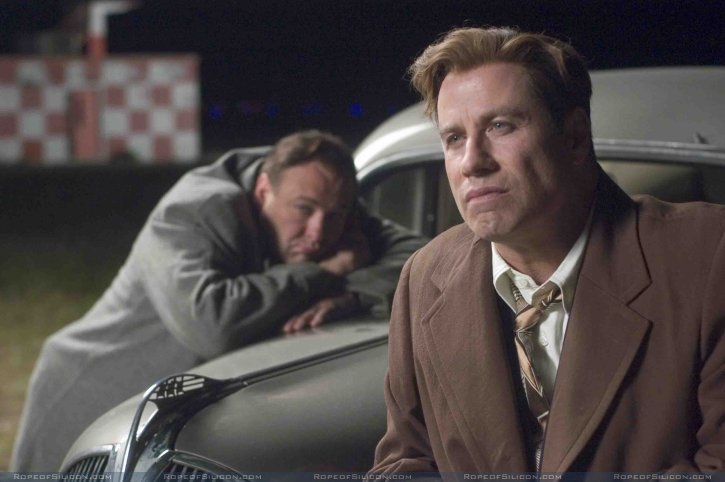
There weren't many stars at the festival, but there were some big ones in another US film, Lonely Hearts (pictured), which is the story of Ray Fernandez and Martha Beck, the infamous "honeymoon killers" of the late 1940s (of Leonard Kastle's legendary 1970 indie, a truly great film), as seen through the eyes of the upstate NY detectives who apprehended them, played by John Travolta and James Gandolfini. The writer-director, Todd Robinson, is the actual son of the Travolta character, who is obsessed with the suicide of his first wife. But reality, lovingly detailed by the period costumes and rich cinematography, goes right out the window when we are introduced to this film's Beck, played so memorably by the plus-sized Shirley Stoler in the Kastle film. Here, Beck, an obese, pathetic, lovelorn harridan, is portrayed by...Salma Hayek, in full glamourpuss mode, with not a hint of Charlize Theron's Monster makeup to make her transformation any more credible. Even if you don't know that Beck looked like, would you believe Hayek as a sex-starved spinster, or that Jared Leto would be ambivalent about her charms (why be a "honeymoon killer" at all, preying on war widows, if you had this hot tamale in your life)? Why did she make this film, and why did Robinson allow her participation, knowing every film critic and true-crime buff worth his or her salt would tear it to pieces based on her casting? Insane...but now I now know why this has failed to graduate from the festival circuit into general release.

The high-octane "heroic bloodshed" crime films John Woo kicked off in Hong Kong 20 years ago have wafted over to Korea, and Kim Sung-su's Ya-Su (Running Wild)is a representative example of the genre, where cops and gangsters go to operatic/melodramatic lengths as they play out their deadly games. Here, a principled prosecutor aligns himself with a lethal weapon of a detective to bring down a politically connected mobster, who also, conveniently, converted to Christianity while in the pokey for his past offenses. The detective, however, has his own purely personal agenda to pursue, making for an eventful, if not particularly inspired, movie.

Titanic goes to war in Otokotachi No Yamato (Yamato), a large-scale Japanese epic whose inspiration was clearly James Cameron's king of the world. The imitation in Junya Sato's film is amusingly slavish, from the flashback structure, the key motifs that bind past and present (a drawing and an amulet), digital effects (highly variable), to the music, right down to a closing credits theme song. What it adds is gory, Saving Private Ryan-level carnage as the Yamato, the world's biggest battleship, comes under attack by Allied bombers as World War II winds down and is sunk; what it lacks is a star-crossed romance to animate the tale emotionally, though if Junya had found one aboard the all-male Yamato this would have been one truly progressive/subversive movie. It's a reverent flag-waver from the losing side that proves that it's pretty hard to get teary-eyed over the fate of a war machine. But it satisfied my need for explosions over so many smaller films.

A crafty Spanish thriller, El Habitante Incierto (The Uncertain Guest), is perhaps a little long, but the length is required for first time writer/director Guillem Morales to spin his Hitchcockian yarn. An architect, Felix (Andoni Gracia), doing repairs on a house, breaks up with his girlfriend (Monica Lopez); soon thereafter, a neighbor appears at the door, needing to use the phone...but he never seems to leave the house, and Felix is soon startled by seemingly spectral apparitions. Through a series of peculiar but logical circumstances Felix finds himself an "uncertain guest" in another neighbor's house, spooking its newly crippled owner (also played by Lopez)...but maybe I've said too much already. I'll only add that the blood-freezing ending brought me up short, in a good way, after the relative lightheartedness of much of the film...

...which is now newly available on DVD here in the States, having bypassed theatrical distribution. I'm glad the Montreal World Film Festival exists for me to have seen it on a big screen with a satisfied audience. You can replicate the experience by renting the disc and eating croissants while watching, but it won't be the same thing.

*I wanted to bolt after Costo's laughable cameo, where a sweet Chinese girl says how "cute" the rotund writer-director is, a sign of a vanity project if there ever was one. But I'm glad I stuck around for at least one scene with co-star Richard Burgi, an actor so wooden in this film you can see the bark. Once the spell of his awfulness was broken I was out of there.

**But perhaps it's our northern neighbor's own doing, in part. ["Blame Canada," as the South Park movie song goes.] An article that ran in the Toronto Globe and Mail during the festival showed that Canada has slipped from an already eyebrow-raising No. 7, given its proximity, to No. 12 on Americans' international itineraries, prompting an editorial, "Hi, World, It's Canada."

***The jokey quality of Snakes on a Plane is rather obscured in this more elegant French translation.

****The Chaos screening ran late, so I missed a final chance to see festival co-winner A Long Walk, from Japan, described by Variety as a "modest nugget" in the festival programming. I arrived too late to Montreal to check out the other winning pic, Brazil's The Greatest Love of All, lambasted by the trade paper as "tired, stilted," which would apply to the one crowned head I did see, the Canadian-financed The Chinese Botanist's Daughters (boy, isn't that a title that will get butts in seats?), a turgid lesbian melodrama distinguished solely by Guy Dufaux's ravishing award-earning cinematography in Vietnam, standing in for China, which apparently took issue with the subject matter. Note to self: Weekends (during which I came to and went from Montreal) are for winning pictures, though not necessarily for the best of a fest.

Friday, August 25, 2006

Before I fly...


I'm off to our northern neighbor on Sunday, to attend the Montreal World Film Festival. For all the places I've been fortunate to visit, I've never been anywhere in Canada, and based on the doleful picture Spike Lee so convincingly paints of the US post-Katrina in his masterful documentary When the Levees Broke (which HBO re-airs in its entirety on Aug. 29, the first anniversary of the hurricane) I may just stay there until 2008, when the ballot boxes can be realigned in my favor. Chilling.

I've never covered a film festival of this breadth before--215 features, plus shorts and documentaries, many of them from local and overseas talent unfamiliar to me. The kindness of other visiting journalists might be of some use to sort it out, though I'll probably just go on instinct and interest level. But Lora says as I was "in training" last week, as I went from showing to screening, taking in no less than three films in six hours on Thursday. I'm the iron man of cinema.

Of course, there was no way I wasn't going to see Snakes on a Plane. Those prankish phone calls weren't for nothing. It pretty much met my expectations, if not New Line Cinema's where the boxoffice was concerned (there's just a ceiling on R-rated horror movie performance, no matter how excited the blogosphere is and how many calls Samuel L. Jackson makes on your behalf). As I said on the Mobius Home Video Forum:

"Saw it today and it surely delivers on its title, but there are plenty of missed opportunities as well...the snakes should have popped up (again!) in the cockpit during the landing, and it missed out, I think, by not "personalizing" the serpents--the big anaconda one (stretching credibility beyond its breaking point, how did they get HIM on the plane?) should have gone one-and-one with Jackson, the cobras should have ganged up for fraternal mischief, etc. We don't really get any sense of them as "characters," though some are quite pretty in their snaky way. I think it would taken more than a few spiked leis to rouse them, however; my impression is like most reptiles, they're often quite dozy, and if this scenario had really played out (as if, in the post 9/11 airline security world) I think the baggage handlers would have found them slumbering in the hold at journey's end.

I laughed when they flew out of the plane at the end. As funny were the R-rated scenes of inadvertent carnage, like the guy who gets the spike heel through his ear, as if the producers didn't want to fire up the workstations once more for snake action so instead turned to the makeup guys and said, "Guys, what can we do here for an effect?""

All I can add is, there better not be any mother----ing snakes on my mother----ing plane.

It occurs to me I never wrote anything about Little Miss Sunshine, which has gone into wider release. I liked the script, the cast, the sweet-and-sour mood...but it didn't really implant itself, and I'm not sure there's all that much more to say. It has a hard shell and a soft center, and goes down as easily, and as swiftly, as tartufo.

I also took in The Bridesmaid, the latest thriller from Claude Chabrol, and other adaptation of a novel by Ruth Rendell, a decade after the superb Le Ceremonie. "Thriller" might be too strong a word for these sinuous, carefully crafted tales; the new one ends with a jolt that is more satisfying emotionally than viscerally, cutting the movie off as surely as an oxygen mask might be severed in a snake-filled plane. It is, however, very meticulously shot (Eduardo Serra), scored (Matthieu Chabrol, his son; his films are rather a cottage industry for his relations, to judge from the credits), and acted, by the intriguingly aquiline Benoit Magimel as an interior designer and Laura Smet as a bridesmaid with designs on him. Coincidentally, my film watching group is taking in Chabrol's Le Boucher (1969) tomorrow evening, as the director continues to ride the French New Wave he helped initiate.

As coincidentally, I went to a screening of Le Petit Lieutenant, a fine French policier starring Smet's mother, the veteran actress Nathalie Baye, in a Cesar-winning turn as an alcoholic police captain and Jalil Lespert (from Laurent Cantet's Human Resources) as her squad's latest recruit. Directed by Xavier Beauvois, the movie (opening Sept. 8) will be a sure-fire hit with anyone who enjoys the British TV drama Prime Suspect, if its distributor, Cinema Guild, puts a few marketing dollars behind it. Baye, whose long career ranges from Day for Night to Catch Me If You Can (as Leonardo DiCaprio's mother), is better-equipped to talk about it than I can, and she did, with my colleague Richard Porton at Cineaste.

It's probably too early, impolitic, or ahead-of-the-curve to talk about the three fall releases I saw, Running with Scissors, Infamous, and Candy. So I won't. Except to say that when movies about dysfunctional families, tormented writers, and drug abuse arrive, the fall prestige-and-awards season has begun, and it may all be enough to make us miss summer superheroes.

To be continued...but first, the late-breaking addition of theater reviews of Mother Courage and Her Children and Martin Short: Fame Becomes Me, from the Live Design magazine website.

Monday, August 21, 2006

Marital milestone


A quite literal milestone at that, ordered by my sister Courtney and my brother-in-law Brian and placed along Baltimore's Inner Harbor...I don't know who this "Rob" fellow is but he is fortunate in his choice, I think he would agree that wedded bliss is sufficient to keep this bond tied for many more a year...

Monday, August 14, 2006

Presto chango


Sleight-of-hand is back in style at the cinema. Going back on my word I found myself at Woody Allen's Scoop the other week, and found it an amusing trifle--what did the critics who trashed this find so special about much earlier wastes-of-effort like Mighty Aphrodite and Hollywood Ending? It's basically a comical counterpoint to Match Point, with Allen pulling the recently deceased Ian McShane out of his hat and mixing it up with journalist Scarlett Johansson (somewhat uncomfortably cast) and her aristocratic quarry, Hugh Jackman. Jackman seemed rather too old, and too tall, to be pursuing the exceedingly petite Johansson but the two are reteaming at Christmas for another abracadabra adventure, Christopher Nolan's The Prestige.

In the meantime, there is The Illusionist (Yari Film Group; opens Aug. 18). The hocus pocus here, which can be credited to the cinematographer, Dick Pope, and the production designer, Ondrej Nekvasil, is taking a modest budget and stretching it to create an excellent facsimile of turn-of-the-20th century Vienna in modern-day Prague, that most adaptable of cities (it stood in nicely for Newark, of all places, in the action-noir Running Scared). Fleshing out a short story by Pulitzer Prize-winner Steven Millhauser, writer-director Neil Burger has himself taken a great leap forward, from a modest two-hander of a debut (Interview with the Assassin) to a luxurious, cast-of-dozens period piece. With a handsome, unusual look that replicates early experiments in color photography, The Illusionist is a pleasure to watch...but maybe not as much to think about.

Which is not to say that The Illusionist is a brainless film. It's just that all this finely wrought craft (including a typically insinuating Philip Glass score) teases us with the expectation that the film might be about something more than a puzzle, which its detective character, Chief Inspector Uhl (Paul Giamatti), unravels with all but a hearty "A-Ha!" at the wrap-up stage. This is very much a dress-up movie, with Giamatti, Edward Norton, and Rufus Sewell, munching on middle European accents, elaborately costumed and coiffed. Norton, whose amazing performance in the criminally overlooked Down in the Valley went far beyond artifice, embraces the opportunity to conceal himself as Eisenheim, an "illusionist" who stuns onlookers with powers that extend all the way to spiritualism. Having none of it, Crown Prince Leopold (a harrumphing Sewell) puts the dogged inspector on Eisenheim's case, to unmask him as a fraud. What the prince does not anticipate is Eisenheim's bottomless love for his intended, Sophie (Jessica Biel), triggering a romantic rivalry with consequences for lives and afterlives.

Edward Norton, Paul Giamatti, Jessica Biel...something would seem to be askew in the talent vector of the film. Compared to her gifted fellows (Sewell is no slouch, either) Biel would seem to be rather ordinary, or worse, but for this one film at least movie magic has been worked. She is perfectly dressed and styled (by Ngila Dickson) as the Polish aristocrat she is playing, as if she had stepped out of a photograph, and the accent is as passable as the rest. The transformation of this valley girl Eliza Doolittle is nothing short of stunning and is the crowning touch of a romantic mystery that is all immaculately polished surfaces.

I had thought The Illusionist would have something stirring beneath its veneer--greater use made, perhaps, of Judaism, or the emergence of psychology, a little more metaphysics, a little less The Usual Suspects, a model for its own twisty alchemy. I guessed wrong, but in a summer that has been parched for more adult entertainment The Illusionist is a beautifully appointed oasis. At the very least it deserves better than its completely unimaginative tagline, "Nothing is what it seems." The movie is called The Illusionist. Like, no kidding. Lure us into the theater with something we don't know.