Friday, September 22, 2006

Crunch 'n munch


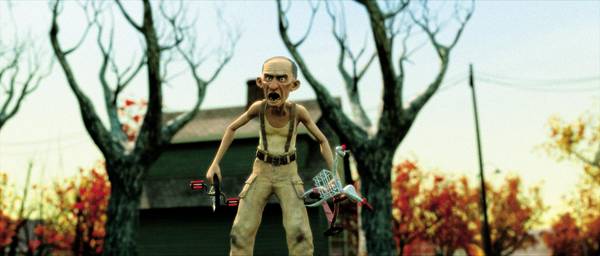
On its third and final attempt, Project Greenlight came up with a real movie--but if you want to see it on the big screen, you'd better hurry, as Dimension Films is giving John Gulager's Feast a midnights-only run tonight and tomorrow before slapping it onto DVD on Oct. 17. The prior films spawned by the HBO/Bravo TV show, Stolen Summer and The Battle of Shaker Heights, served only to prove that good movies could not be willed into existence by reality television; I had to look up their titles on the web, so lackluster and unmemorable were they. I'm not sure Feast, a down-and-dirty contrast to the highmindedness and pretension of the other two, is all that good a movie, either, and the cramped, closed-in, claustrophobic images and strobe-fast editing will probably play more comfortably on the small screen than the large.

But Feast feels like a real movie, and the audience I saw it with ate up its zilch-budget exuberance. Their response was a rebuke to co-producer Matt Damon, who was reportedly unhappy that a dumpster-dive into horror movies was going to be Greenlit, and I must say it was an easier sit for me than most of the films released thus far by The Weinstein Company, which should have gone through a TV vetting process. Feast has a simple sharks-circling-swimmers premise, in the tradition of The Birds, Night of the Living Dead, The Evil Dead or From Dusk Till Dawn: The last-call patrons of the Beer Trap Tavern, a Tex-Mex dive bar, find themselves besieged by "monkey motherfuckers," unexplained cannibalistic humanoids who wear the skins of their victims. In a novel meta-movie touch, the one-dimensional characters, played with sufficient conviction by actors whose ever-dwindling number includes Balthazar Getty, Jason Mewes, Henry Rollins, and veteran Clu Gulager, the director's father, are introduced via freeze frames, with text boxes that give their designation-type names (Bartender, Harley Mom, Vet) and life expectancy. Note: Don't believe everything you read.

[The audience favorite was Eileen Ryan, who, as Grandma, does what Walter Matthau does in Earthquake and responds to the crisis by getting more drunk. Ryan is also in her son, Sean Penn's, new film All the King's Men, but I bet this one was a lot more fun to make.]

Feast was written by Marcus Dunstan and Patrick Melton, who, as the draft press notes tell us, "served in the same fraternity at the University of Iowa and both found themselves in Los Angeles in 1999 with an idea about monsters attacking a tavern." Well, we've all been there, but credit to them for actually following through with it, and Gulager for directing it with the press-kit's "velocity and ferocity." Maybe too much of both; the 88-minute movie streaks by in a blur of salty dialogue and a flesh-ripping action, mowing down the cliches of the genre without taking a stand and carving a truly distinctive mark of its own.

Feast is raucously scary/funny, however, in its beer-bust fashion, and I wish I tuned into the show to see how Gary J. Tunnicliffe and Kevin O'Neill created its convincing, no-budget makeup and visual effects. If nothing else, Feast passes the smell test--it's a bonafide film, one that turns the limitations of Project Greenlight into a plus in its proudly ramshackle way, and not a wan extra to accompany the release of the show's last season on DVD.

Tuesday, September 19, 2006

Gumshoes


The Tuesday after a film's release is an eternity in web time, and Brian De Palma's The Black Dahlia has been picked over pretty cleanly by now by the usual suspects. Seitz, who went out on a limb on behalf of critical and audience orphans The New World and Miami Vice, is thumbs way up, higher than any review I've seen; even his (former?) New York Press colleague, Armond White, a noted De Palma defender/apologist, was at half-mast. Check the comments section of Seitz's post for a very poor case made by the De Palma prosecution, written for MSNBC.com, which I've written for in the past, and which should know better (or apply editing shears more liberally).

I've swooned over the seductive, elegantly executed ironies, humors, and cruelties of De Palma's films for decades. My enthusiasm has faded in the wake of so many half-realized, or simply unrealized, efforts since the career ground zero of The Bonfire of the Vanities (1990), with the more independently realized Raising Cain (1992) and Femme Fatale (2002) the standouts, and 1996's Mission: Impossible the most flagrantly borrowed from (at this point more filmmakers have lifted from De Palma than he ever took from Hitchcock). 1993's Carlito's Way is a film whose reputation has grown considerably in the interim since its release. But from 1973's Sisters to 1989's Casualties of War there wasn't another filmmaker I was more consistently interested in, and seeing Dressed to Kill with my unsuspecting mom and my aunt at a New Jersey shore multiplex in the summer of 1980 was a joy. How shocked and delighted we were, which is the way I come out of his best films.

The Black Dahlia , with its loopy, Big Sleep-type plot, is borderline. He and James Ellroy, a sledgehammer prose stylist whose last novel, The Cold Six Thousand, was so terse as to be near-unreadable, are not a good match. Here's what I had to say about the film on the Mobius Home Video Forum, which is linked at right:

"I was predictably mixed on Dahlia--didn't laugh at it (well, Fiona Shaw is pretty over-the-top, a one-woman setpiece who didn't any 180-degree tracking shots for animation) but never really got deeply into it. I read all of Ellroy's books prior to seeing L.A. Confidential--loved them, like meteors, however, his ability seemed to flame out. I would have left more of the text on the cutting room floor, frankly, allowing De Palma to do more of his stuff (there's not nearly enough of his cinekinetics here, and too much that plays to his weaknesses)--it's a movie that's bound to frustrate De Palma and Ellroy fans alike (I'm not sure his work is all that adaptable, or like Confidential adaptable only in part, with much revision).

Camerawork and production design are all aces--but were U.S. steering wheels ever on the right? In Bulgaria, the country of most filming, I assume, yes. Acting is variable--Josh Hartnett's face is bound to harden into a Charles Bronson death mask, but that's a few years off. He's not bad but Scarlett Johansson really seemed stranded, not at all period, and neither seemed at ease with their cigarettes.

I had heard De Palma was going to film the spooky novel Toyer, to star Colin Firth and Juliette Binoche, but that seems to have fallen into development hell.

The one thing I like about De Palma is that, according to Film Comment, he's the one noted filmmaker who avidly attends film festivals--not, or not just, to see his movies off, but to watch many others as well, clad in his familiar safari suits. I admire that commitment."


My mom's recommendation steered me toward the terribly titled Hollywoodland--who wants to see a movie called that?--for a double dose of L.A. Law, period-style. As I noted, "It's flatly directed by Sopranos veteran Allen Coulter and TV-looking, no great shakes--but it got under my skin in a way the all-surfaces Dahlia didn't. Adrien Brody's too-large part tracking the 'killer' of George Reeves is a bother but Ben Affleck, Diane Lane, Bob Hoskins, Lois Smith, and Jeffrey DeMunn, among others, give more deeply felt, at times touching performances as their true-to-life (if not altogether true-life) characters chafe under the blanket of tinsel. It's a good double-header with Dahlia but will of course go well with the Reeves Superman TV shows when it reaches DVD."

Elaborating a bit further, further than the film itself goes, Hollywoodland takes place roughly between 1951-1959, as the studio system was collapsing. Its weapons of subservience, molly-coddling and intimidation, were applied without the velvet gloves, and the film conjures the specters of blacklisting--not just of suspected communists but homosexuals and anyone who failed to toe the line, in this case a stock actor (played by a stock actor whose career wounds were largely self-inflicted) who was never quite able to secure a strong foothold in his world (Brody's fictional character, a failed detective and father sniffing out clues to foul play in his death, is his mirror image).

Hollywoodland gives you more to chew on once you've left the theater, which as I've written before is the best you can ask from a movie that doesn't quite add up while watching it. But, forget it, Jake--neither of these films is Chinatown, the classic of its kind.

Saturday, September 16, 2006

Into thin air


An MGM release opening this Friday, Flyboys, is meant to play exactly like an MGM release that might have opened in September 1936. The difference is that moviemakers then weren't striving to make "old-fashioned" films; the medium was too new for that. This movie, from journeyman director-for-hire Tony Bill and once-hot producer Dean Devlin (who chilled considerably after the useless Americanized Godzilla picture), assumes that audiences like to be bored into submission by exciting true-life stories (in this case, the Lafayette Escadrille flying aces of World War I) that have been very blandly fictionalized and presented with agonizing reverence, as if the screenings were going to be held in churches and not multiplexes. Memo: Audiences didn't flock to see, say, 1938's The Dawn Patrol or 1965's The Blue Max for stone-faced lectures on warfare, racism, or class and county distinctions. They went for the stars, the sex (in the 1965 movie, anyway), and the dogfights. Of these, Flyboys has only the third, and not enough airborne footage to justify a two hour-plus running time.

The photo comes from the best of the battle sequences, where the "flyboys"--who are helping the French cause before America entered the Great War--take on a marauding German zeppelin. It's a beautifully rendered, exciting sequence, that might really take off in Imax 3D...but note the use of the word "rendered," as in computer-generated. The flying scenes in this picture are all at workstation level; you never really feel like you're up in the air with the characters, but back in Keanu Reeves' matrix, which has been reprogrammed to simulate France 90 years ago*. The older pictures used models and mattes for their in-air action--they may not be as "convincing" as digital effects but they feel built, and more substantial.

It helps, too, that the airmen were made of flesh-and-blood, and not cardboard. Read about the Lafayette Escadrille here. Interesting, no? There's a whole movie in the story of Eugene Bullard, the black "flyboy," but I wouldn't trust these filmmakers to do this fascinating American life justice--the Bullard character here represents nothing more than a black guy whose noble supporting-part presence everyone else must learn to accept. James Franco, Hollywood's go-to guy for stiff historical pictures when Colin Farrell is unavailable, plays the lead, who befriends and beds a refugee when on the ground; as the squadron leader, Jean Reno plays Jean Reno. No one else makes the slightest impression. "Old-fashioned" is not synonymous for "dull"--we love those Turner Classic Movies movies for their spark and zest, two qualities not much in evidence in Flyboys.

*Flyboys is curiously out of time. I remember being annoyed with another flying picture, 1986's Iron Eagle, which pushed Reagan-era propaganda on its audience. Flyboys has no agenda. It's as apolitical as it is ahistorical, and its appeal would appear limited for anyone who is not a World War I buff to begin with--and those History Channel watchers will object to the liberties taken. Why was this picture made?

Notes from a Farmiga fan


The New York Times Magazine (Sept. 3) spotlit an excellent profile of the rising young film actress Vera Farmiga, whose career I've been following with interest for some time now. [Think Anne Heche without the celestial personalities, though I don't wish to file her away her in a career cubbyhole with other performers she sort-of reminds me of.] "Trying to follow" might be more like it; as the article, by Lynn Hirschberg, notes, many of her independent credits fly below the radar, and I missed her award-winning turn as a recovering addict in last year's Down to the Bone, which I'll be sure to catch when it hits DVD on the 26th.

It's one of the richer Times Magazine performer profiles I've read, if not as "juicy" as say, their classic Julia Ormond piece in 1995, which helped end her US career when she had a few unkind things to say about her Hollywood overseers. What piqued the Times' interest was her heightened visibility, similar to Ormond's breakout, in her two fall releases, Martin Scorsese's The Departed and Anthony Minghella's Breaking and Entering, for which she got nice notices at the Toronto film festival. She's not too crazy about her role in the Scorsese film, a testosterone-dripping boys' club movie if there ever was one, and wasn't afraid to say so, nor was she shy about assessing scripts, her own ability, and fellow talent in an honest, non-judgmental way.

What really got me on her side was this quote, though, about the promotion of the film Running Scared, one of the year's livelier pictures. Its website allowed you to toy with her image, rendered as a cartoon, as she has sex with co-star Paul Walker in a scene from the film. Circumspect at the time, she told Hirschberg, "it can be impossible to preserve a noble image in this industry. I gave them a very respectful portrait. It was reduced to pornography for the sake of marketing. And I thought it was shameful."

Well-put. So I feel a little protective of Vera Farmiga, a bonafide Jersey girl, and must disagree with a letter about the piece that appears in this Sunday's magazine. The writer, Jon Pollack, is from the Pacific Palisades, and from Googling I suspect he's a TV producer, with credits that include the short-lived series Joey and Father of the Pride. [It's just a guess.] "Is it possible that Farmiga just isn't that great?" he writes, after rattling off the names of "wonderful contemporary actress" including Nicole Kidman, Catherine Keener, and Annette Bening, all A-OK--and all of whom have felt quite keenly the same frustration that Farmiga has (it shows in their haphazard credits as they negotiate the same mindfield toward better parts). I can't really blame Pollack for not having seen any of her films, but it was the Times that was comparing her to Meryl Streep, not herself--and while I often disagree with dispatches from their cultural desk I think it might be right to do so this time. We'll see.

In any event, indulging in the kind of easy putdown the actress would abhor, I would say to Pollack that she's clearly more gifted than Matt LeBlanc or a bunch of talking cartoon lions.

Friday, September 15, 2006

Uncomplicated Joy


A new film, Kelly Reichardt's Old Joy(Kino International), is already a time capsule, from the yesteryear of late 2004 and early 2005, when the price of a gallon of regular gas was $2.18 and road trips like the one portrayed were a little easier on the wallet. Still, the movie would argue (not that it is an argumentative piece in the least) that the trips are worth the effort, a balm for troubled relationships and the vague uneasiness about life in general that no one is immune from. The journey here, encapsulated in 76 minutes, is from Portland, OR, to the Cascade Mountains; the not-altogether-happy campers, though no finger of blame is placed, are the holistic-minded Kurt, an itinerant deep into his 30s (and played by musician/actor Will Oldham, pictured below), and the married Mark (character actor Daniel London, a familiar face since the late 90s), who is expecting his first child. Mark's dog also pads around.

No Sideways-type hijinx here with merlot and babes; the film, co-written by Reichardt and Jonathan Raymond and based on Raymond's short story (which is illustrated with Justine Kurland's naturist, utopian-recalling photographs), is stripped to its literal bare essence, as the two men, unwinding at a hot spring in the forest*, bridge their divide, then part, perhaps forever. There are half-joking observations, mostly from the more talkative Kurt ("There's no difference anymore between the city and the forest. The city is full of trees, and the forest is full of garbage"), and a lot of long takes, where the cinematographer, Peter Sillen, gracefully shoots the open road and enclosing woodlands, and a score by Yo La Tengo idles safely below the speed limit.

Old Joy, which opens Sept. 20 at Film Forum in Manhattan, is a kind of litmus test for film reviewers. The "right" kind appreciate its melancholic, meditative qualities, and find a place for it with other road movies like Two-Lane Blacktop of Kings of the Road; the rest nod off intermittently, and exit the theater groggy and irritated, feeling boobish and had ("another festival favorite that died off the circuit," I can hear them muttering). I'm somewhere in the middle, admiring the craft and the hushed mood but, as happens so often with American indies, feeling slightly famished afterwards. The driving scenes are punctuated by on-air chatter from the liberal radio station Air America: Bush, the false recovery, etc. The movie suggests that we turn down the volume long enough to recourse and appreciate the other things that matter before reentering the fray and challenging the political status quo, but this dimension is frustratingly unexplored. This is cinema by wavelength--if you get on it, fine, if you don't, like, it's no big deal. Old Joy is ambitious and unambitious all at once.

[And, with midterm elections coming up, after a pileup of administration inadequacies that need to be exploited, I would have thought the last time for contemplation would have been back when gas cost $2.18 a gallon. Democrats have been on a road trip, befogged by their acquiescence and disillusionment, long enough.]

*I had to chuckle at the final end credit, which states that the real-life retreat the movie refers to does not allow alcohol or nudity. Anyone inspired to look for that kind of utopia by this film better look elsewhere for it in the Pacific Northwest.

Thursday, September 14, 2006

Mum's the word


Rowan Atkinson gives an astonishingly quiet performance in Niall Johnson's not-quite-black-enough comedy Keeping Mum, which Thinkfilm releases today in the States. It's not Mr. Bean-quiet, with his pratfalls, but detailed character work, as a gently addled vicar who has lost touch with his wife (Kristin Scott Thomas) and children. Driven to distraction, Thomas contemplates an affair with golf-teaching Lothario Patrick Swayze, an American who has rather improbably found a new swing in postcard-pretty Cornwall, lovingly filmed in widescreen by Gavin Finney. The domestic distress is firmly settled by the new housekeeper, Maggie Smith, whose problem-solving skills are on the lethal side. The makings of a rollicking farce are there, but Johnson and co-writer Richard Russo (in an unanticipated departure from more keenly observant New England-set novels and films like Nobody's Fool and Empire Falls) err toward mildness. The movie only takes off briefly toward the end, when Smith accumulates one corpse too many in the course of her family therapy, then decelerates again toward a sour closing shot that clashes with the The Trouble with Harry-style storyline.

The actors don't really mesh, either. Thomas so convincingly enacts a middle-aged wistfulness you almost believe her falling for Swayze, whose hearty leering seems to have drifted in from another kind of movie altogether (and I can't begin to imagine what's happened to his face; age, or enhancement, or an unhappy melding of the two). Smith is regally funny even without the right material to play off from--but how much more amusing it would be to see her match wits with the serpent-tongued Atkinson from just about my favorite TV sitcom, Blackadder. They'd really slay an audience, but, with the British comic in harness this time, Keeping Mum settles for a little criminal mischief instead.

Monday, September 11, 2006

Tribute in Light '06


Not the greatest shot, I know, but taken with admiration from the courtyard of my home in Brooklyn. The twin towers are there; as arresting was the effect as viewed through the many white clouds on this clear evening, which I tried, however vainly, to capture.

Thursday, September 07, 2006

From the Useless Remakes Department

Reports this morning's Variety: "The Jude Law-Michael Caine remake of Sleuth is a go, with Kenneth Branagh on board to direct an adaptation of the Anthony Shaffer play, scripted by Harold Pinter."

How wrong is this? Let us count the ways:

1) Law--duller than Hollywood thinks he is, overexposed, spent force.
2) Caine--miscast in the Olivier part. Clearly money-grubbing (a career trait) after the awful Get Carter remake, which he appeared in, and apparently all-too-willing to overlook Law's uninspired performance in the forgettable Alfie remake.
3) Branagh--how his stock has fallen, to take this on.
4) Pinter--Let's hope he has at least one great work left in him and doesn't kick off with this thing as the last marker for his tombstone. Was he paid to blow the dust off the pages of the original script and screenplay? There's no way to reinvent this particular wheel.

Consolation: The remake will no doubt occasion a 35th-anniversary DVD of the original next year, which was all that was really required.

Falcon found at sea

The New York Times is reporting corporate scandal at Hewlett Packard, as board member Thomas J. Perkins quits over a controversial leak investigation. But here's the bit I liked in Damon Darlin's article:

"Mr. Perkins, who was briefly married to the best-selling author Danielle Steel and recently wrote a racy novel titled Sex and the Single Zillionaire, did not respond to requests for comment. A representative said Mr. Perkins was in the Mediterranean on his new $100 million 287-foot yacht, the Maltese Falcon, and did not want to be disturbed."

Leaving aside the quickie marriage and book, seemingly exhumed from an episode of Lifestyles of the Rich and Famous circa 1987, there's the name of the boat. Perkins clearly likes crime fiction, in book and movie form, and I'm sure when he welcomes his moneyed friends aboard and they ask him about the name, he says, quoting the last line of the 65-year-old film classic, "Don't you remember...it's the stuff that dreams are made of."

But, Tom--surely you get the irony? The Maltese Falcon, when finally revealed, is lead...a fake, a phony. An illusion. A phantom. Ever-elusive, and not to be had for any price, not even $100 million. [Except as a book or a DVD; Warner Bros. is releasing a three-disc version of the movie this fall.]

I wouldn't trust a guy who didn't grasp this. Cute, Mr. Perkins, but shallow. What's next for your fleet: The Treasure of the Sierra Madre?

Wednesday, September 06, 2006

New from Cineaste

Be a good filmgoer and check out the latest updates to the Cineaste website...or Bettie Page will give you a whack.

Monday, September 04, 2006

The other Canadian film festival


Venice. Telluride. Toronto. The late summer film festivals, the ones where the big fall and winter releases are first put on display, like Fashion Week for cinema.

And then there is...Montreal. Specifically, the Montreal World Film Festival, which is celebrating its 30th anniversary year, a milestone it almost didn't reach. A near-death experience last year saw some of its key local backers throw their funding behind an upstart get-together that proved DOA. "Don't call this year a 'revival,'" a festival honcho told me. "After all, we never went away."

And so it's back, ending tonight since starting up on Aug. 24. But I was a little surprised to find that more than a few folks wish it would just sort of fold up its tent and go away. The selections, 215 feature films from 76 countries, plus 150-odd documentaries and shorts, is lackluster, I heard--slots are programmed, but not curated with any particular taste or sensibility. Its founder, 75-year-old Serge Losique, should hand over the reins to someone more discerning, if the thing should continue at all. The festival is weakly promoted, its phone book-size catalog, lifeless. The Festival du Noveau Cinema, held in October, is infinitely edgier, better.

This is no glamourfest. Quebec's biggest star, Roy Dupuis, put in an appearance, promoting what turned out to be one of the festival's better films, the intensely spiritual thriller That Beautiful Somewhere, a promising debut from 32-year-old Robert Budreau. [You may remember Dupuis from the La Femme Nikita TV show, or Jesus de Montreal.] The lovely Vivian Wu and her filmmaker husband, Oscar Luis Costo, had breakfast a table across from me at the Hyatt Regency Montreal, but I hid from them behind a croissant, as I had walked out of their thrill-less thriller, Shanghai Red, the afternoon before, and I think they saw me.* And that was it. If competition juror Kathy Bates was around I didn't see her, and given the absence of star power she would have been conspicuous in her presence. The Champ Car racers and Air Canada stewardesses staying at the hotel got more attention.

This was my first trip to Montreal, indeed, my first trip to Canada, which is rather shameful.** And, once dreadful rain ended last Sunday, my first of six days at the festival, the city put its best foot forward with the kind of delightful, late summer/early fall weather Al Gore warns us that the Lower 48 may never experience again. I was amused at how nonchalant the zoning is; here in NY, the remaining sex shops and strip clubs have been carefully Balkanized, but on Rue St. Catherine, where the hotel is, they're right next to the fashionable restaurants and shops, in all their fleshpotty, neon glory. [Straight pleasures to the west, where St. Catherine resembles a cleaner Eighth Avenue, gay to the east, mimicking Christopher Street--as for my own participation in the seamier side of city life, what happened in Montreal, stays in Montreal.] The Old City and Old Port fully lived up to their billing as North America's most charming European neighborhoods, and the view from Mont Royal is worth the climb, though you may want to take the more direct route up (which we, natch, did not discover until after the ascent had been made). Duluth Street is home to a matchless French restaurant, The Little Onions, which offered veal and Cornish hen I still savor days later.

And, oh, yes, there were movies, too. Cineaste hadn't sent me to sight-see and eat fancy French dinners (and given the strong Canadian dollar's distressing effect on my wallet there wasn't much of that carrying-on anyway) so I gamely trotted up and down Rue St. Catherine, between the royally appointed Cinema Imperial (host to the competition entries) and the Latin Quarter's Cineplex Odeon, where the flotsam and jetsam of the international market and prior festivals put in appearances. The multiplex (showing Serpents a Bord on one screen***) has an "Alan Smithee Cafe," which seems right, given the anonymous (if not pseudonymous) quality of so many of the movies. They're so under-the-radar the reliable Greencine Daily didn't pick up any coverage that I could detect, and the trades reviewed just a handful of the premieres. This may be the last you'll read about some of these...and I promise to say no more about the least of them, including Shanghai Red, a well-intentioned but pointless remake of 1953's timeless Little Fugitive, a flatfooted Chinese competitor about the making of the nation's first movie in 1905, Ding Jun Shan (showing that Hong Kong still has a thing or two to teach the mainland about comedy-drama), and a disastrously pseudo-pretentious Greek film, The Last Porn Movie (no porn, no movie), if you promise not to see them should they bob up at your local cinema like so many creaking ghost ships.


I'm obliged to save the best for Cineaste. These would include the strongest film I saw, the one everyone I met was buzzing about, the US-Cambodian co-production Holly, about child prostitution and sex tourism, co-written and directed by Guy Moshe; Budreau's film, pictured; a Canadian documentary from the much-respected Alanis Obomsawim, Waban-aki: People of the Rising Sun, about her Indian heritage; a good Chinese melodrama centered on deforestation, Tian Gou (The Forest Ranger); the best of the competition entries I saw, the intriguing if not altogether successful Peruvian revenge picture Mariposa Negra (Black Butterfly), set in the Fujimori era; and a pacy, surprising, and exceedingly well-acted Spanish crime drama, Segundo Asalto (Round Two), which some enterprising distributor unafraid of subtitles really should pick up.

That still leaves a few pictures worth blogging about, for this and that reason, and one or two worth seeing, should the distribution gods smile upon them.

Montreal audiences are unfailingly polite, applauding at the end of just about anything--whether out of acknowledgment, or relief, was sometimes unclear. But there wasn't much clapping at the end of over two hours of Chaos, a Polish premiere that marks the feature debut of Xawery Zulawski, the son of the provocative Andrzej Zulawski, whose film 1978 Possession, with Isabelle Adjani giving birth to a slimy monster in the Paris Metro, remains a head-turner (and head scratcher). The film is nominally about three stepbrothers in Poland as the country prepares to join the European Union; it's really about endless fiery confrontations between the characters, sex tapes, punk rock, vandalism, explosive destruction, and coming-of-age in looser, freer times than older generations had. It's exhilaratingly filmed and I liked a lot of it, though I had no real way into the movie. Zulawski was there but I didn't have a chance to ask him what Chaos was about (what is chaos ever about) or if the entire movie was just a case of proving that where the Zulawskis are concerned the apple doesn't fall too far from the tree.****


A US film, The 4th Dimension, isn't an easy movie to fall into, either, opening as it does with a burst of mathematics and time theorems reminiscent of micro-budgeted mind-crogglers like Pi and Primer. The shot-on-digital-video work of two Temple University graduates, Tom Mattera and Dave Mazzoni, the film tells, sometimes in flashbacks (or is it a parallel dimension?), the story of Jack, a child prodigy in quantum physics and molecular biology. As a mysteriously traumatized adult Jack fritters his life away studying the clocks at the antiques store where he works, till he finds a journal, purportedly penned by Albert Einstein, that may hold the key to the strange netherworld in which he lives. The black-and white film bursts into smeary color for the finale, which, like Jacob's Ladder, adds a real-life sociopolitical "dimension," as it were, to the tale. That I understood, but sci-fi buffs who were more on the film's earlier wavelength may feel let down.

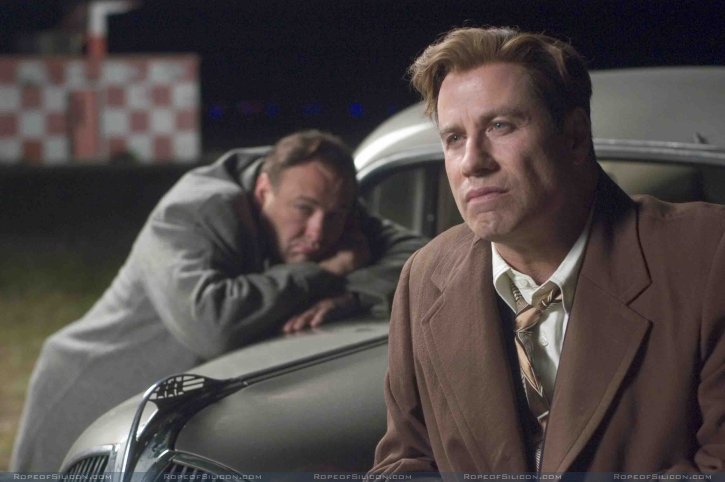
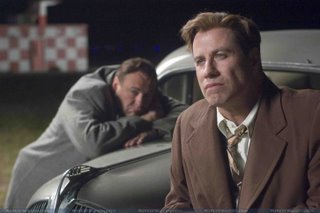
There weren't many stars at the festival, but there were some big ones in another US film, Lonely Hearts (pictured), which is the story of Ray Fernandez and Martha Beck, the infamous "honeymoon killers" of the late 1940s (of Leonard Kastle's legendary 1970 indie, a truly great film), as seen through the eyes of the upstate NY detectives who apprehended them, played by John Travolta and James Gandolfini. The writer-director, Todd Robinson, is the actual son of the Travolta character, who is obsessed with the suicide of his first wife. But reality, lovingly detailed by the period costumes and rich cinematography, goes right out the window when we are introduced to this film's Beck, played so memorably by the plus-sized Shirley Stoler in the Kastle film. Here, Beck, an obese, pathetic, lovelorn harridan, is portrayed by...Salma Hayek, in full glamourpuss mode, with not a hint of Charlize Theron's Monster makeup to make her transformation any more credible. Even if you don't know that Beck looked like, would you believe Hayek as a sex-starved spinster, or that Jared Leto would be ambivalent about her charms (why be a "honeymoon killer" at all, preying on war widows, if you had this hot tamale in your life)? Why did she make this film, and why did Robinson allow her participation, knowing every film critic and true-crime buff worth his or her salt would tear it to pieces based on her casting? Insane...but now I now know why this has failed to graduate from the festival circuit into general release.

The high-octane "heroic bloodshed" crime films John Woo kicked off in Hong Kong 20 years ago have wafted over to Korea, and Kim Sung-su's Ya-Su (Running Wild)is a representative example of the genre, where cops and gangsters go to operatic/melodramatic lengths as they play out their deadly games. Here, a principled prosecutor aligns himself with a lethal weapon of a detective to bring down a politically connected mobster, who also, conveniently, converted to Christianity while in the pokey for his past offenses. The detective, however, has his own purely personal agenda to pursue, making for an eventful, if not particularly inspired, movie.

Titanic goes to war in Otokotachi No Yamato (Yamato), a large-scale Japanese epic whose inspiration was clearly James Cameron's king of the world. The imitation in Junya Sato's film is amusingly slavish, from the flashback structure, the key motifs that bind past and present (a drawing and an amulet), digital effects (highly variable), to the music, right down to a closing credits theme song. What it adds is gory, Saving Private Ryan-level carnage as the Yamato, the world's biggest battleship, comes under attack by Allied bombers as World War II winds down and is sunk; what it lacks is a star-crossed romance to animate the tale emotionally, though if Junya had found one aboard the all-male Yamato this would have been one truly progressive/subversive movie. It's a reverent flag-waver from the losing side that proves that it's pretty hard to get teary-eyed over the fate of a war machine. But it satisfied my need for explosions over so many smaller films.

A crafty Spanish thriller, El Habitante Incierto (The Uncertain Guest), is perhaps a little long, but the length is required for first time writer/director Guillem Morales to spin his Hitchcockian yarn. An architect, Felix (Andoni Gracia), doing repairs on a house, breaks up with his girlfriend (Monica Lopez); soon thereafter, a neighbor appears at the door, needing to use the phone...but he never seems to leave the house, and Felix is soon startled by seemingly spectral apparitions. Through a series of peculiar but logical circumstances Felix finds himself an "uncertain guest" in another neighbor's house, spooking its newly crippled owner (also played by Lopez)...but maybe I've said too much already. I'll only add that the blood-freezing ending brought me up short, in a good way, after the relative lightheartedness of much of the film...

...which is now newly available on DVD here in the States, having bypassed theatrical distribution. I'm glad the Montreal World Film Festival exists for me to have seen it on a big screen with a satisfied audience. You can replicate the experience by renting the disc and eating croissants while watching, but it won't be the same thing.

*I wanted to bolt after Costo's laughable cameo, where a sweet Chinese girl says how "cute" the rotund writer-director is, a sign of a vanity project if there ever was one. But I'm glad I stuck around for at least one scene with co-star Richard Burgi, an actor so wooden in this film you can see the bark. Once the spell of his awfulness was broken I was out of there.

**But perhaps it's our northern neighbor's own doing, in part. ["Blame Canada," as the South Park movie song goes.] An article that ran in the Toronto Globe and Mail during the festival showed that Canada has slipped from an already eyebrow-raising No. 7, given its proximity, to No. 12 on Americans' international itineraries, prompting an editorial, "Hi, World, It's Canada."

***The jokey quality of Snakes on a Plane is rather obscured in this more elegant French translation.

****The Chaos screening ran late, so I missed a final chance to see festival co-winner A Long Walk, from Japan, described by Variety as a "modest nugget" in the festival programming. I arrived too late to Montreal to check out the other winning pic, Brazil's The Greatest Love of All, lambasted by the trade paper as "tired, stilted," which would apply to the one crowned head I did see, the Canadian-financed The Chinese Botanist's Daughters (boy, isn't that a title that will get butts in seats?), a turgid lesbian melodrama distinguished solely by Guy Dufaux's ravishing award-earning cinematography in Vietnam, standing in for China, which apparently took issue with the subject matter. Note to self: Weekends (during which I came to and went from Montreal) are for winning pictures, though not necessarily for the best of a fest.

Friday, August 25, 2006

Before I fly...


I'm off to our northern neighbor on Sunday, to attend the Montreal World Film Festival. For all the places I've been fortunate to visit, I've never been anywhere in Canada, and based on the doleful picture Spike Lee so convincingly paints of the US post-Katrina in his masterful documentary When the Levees Broke (which HBO re-airs in its entirety on Aug. 29, the first anniversary of the hurricane) I may just stay there until 2008, when the ballot boxes can be realigned in my favor. Chilling.

I've never covered a film festival of this breadth before--215 features, plus shorts and documentaries, many of them from local and overseas talent unfamiliar to me. The kindness of other visiting journalists might be of some use to sort it out, though I'll probably just go on instinct and interest level. But Lora says as I was "in training" last week, as I went from showing to screening, taking in no less than three films in six hours on Thursday. I'm the iron man of cinema.

Of course, there was no way I wasn't going to see Snakes on a Plane. Those prankish phone calls weren't for nothing. It pretty much met my expectations, if not New Line Cinema's where the boxoffice was concerned (there's just a ceiling on R-rated horror movie performance, no matter how excited the blogosphere is and how many calls Samuel L. Jackson makes on your behalf). As I said on the Mobius Home Video Forum:

"Saw it today and it surely delivers on its title, but there are plenty of missed opportunities as well...the snakes should have popped up (again!) in the cockpit during the landing, and it missed out, I think, by not "personalizing" the serpents--the big anaconda one (stretching credibility beyond its breaking point, how did they get HIM on the plane?) should have gone one-and-one with Jackson, the cobras should have ganged up for fraternal mischief, etc. We don't really get any sense of them as "characters," though some are quite pretty in their snaky way. I think it would taken more than a few spiked leis to rouse them, however; my impression is like most reptiles, they're often quite dozy, and if this scenario had really played out (as if, in the post 9/11 airline security world) I think the baggage handlers would have found them slumbering in the hold at journey's end.

I laughed when they flew out of the plane at the end. As funny were the R-rated scenes of inadvertent carnage, like the guy who gets the spike heel through his ear, as if the producers didn't want to fire up the workstations once more for snake action so instead turned to the makeup guys and said, "Guys, what can we do here for an effect?""

All I can add is, there better not be any mother----ing snakes on my mother----ing plane.

It occurs to me I never wrote anything about Little Miss Sunshine, which has gone into wider release. I liked the script, the cast, the sweet-and-sour mood...but it didn't really implant itself, and I'm not sure there's all that much more to say. It has a hard shell and a soft center, and goes down as easily, and as swiftly, as tartufo.

I also took in The Bridesmaid, the latest thriller from Claude Chabrol, and other adaptation of a novel by Ruth Rendell, a decade after the superb Le Ceremonie. "Thriller" might be too strong a word for these sinuous, carefully crafted tales; the new one ends with a jolt that is more satisfying emotionally than viscerally, cutting the movie off as surely as an oxygen mask might be severed in a snake-filled plane. It is, however, very meticulously shot (Eduardo Serra), scored (Matthieu Chabrol, his son; his films are rather a cottage industry for his relations, to judge from the credits), and acted, by the intriguingly aquiline Benoit Magimel as an interior designer and Laura Smet as a bridesmaid with designs on him. Coincidentally, my film watching group is taking in Chabrol's Le Boucher (1969) tomorrow evening, as the director continues to ride the French New Wave he helped initiate.

As coincidentally, I went to a screening of Le Petit Lieutenant, a fine French policier starring Smet's mother, the veteran actress Nathalie Baye, in a Cesar-winning turn as an alcoholic police captain and Jalil Lespert (from Laurent Cantet's Human Resources) as her squad's latest recruit. Directed by Xavier Beauvois, the movie (opening Sept. 8) will be a sure-fire hit with anyone who enjoys the British TV drama Prime Suspect, if its distributor, Cinema Guild, puts a few marketing dollars behind it. Baye, whose long career ranges from Day for Night to Catch Me If You Can (as Leonardo DiCaprio's mother), is better-equipped to talk about it than I can, and she did, with my colleague Richard Porton at Cineaste.

It's probably too early, impolitic, or ahead-of-the-curve to talk about the three fall releases I saw, Running with Scissors, Infamous, and Candy. So I won't. Except to say that when movies about dysfunctional families, tormented writers, and drug abuse arrive, the fall prestige-and-awards season has begun, and it may all be enough to make us miss summer superheroes.

To be continued...but first, the late-breaking addition of theater reviews of Mother Courage and Her Children and Martin Short: Fame Becomes Me, from the Live Design magazine website.

Monday, August 21, 2006

Marital milestone


A quite literal milestone at that, ordered by my sister Courtney and my brother-in-law Brian and placed along Baltimore's Inner Harbor...I don't know who this "Rob" fellow is but he is fortunate in his choice, I think he would agree that wedded bliss is sufficient to keep this bond tied for many more a year...

Monday, August 14, 2006

Presto chango


Sleight-of-hand is back in style at the cinema. Going back on my word I found myself at Woody Allen's Scoop the other week, and found it an amusing trifle--what did the critics who trashed this find so special about much earlier wastes-of-effort like Mighty Aphrodite and Hollywood Ending? It's basically a comical counterpoint to Match Point, with Allen pulling the recently deceased Ian McShane out of his hat and mixing it up with journalist Scarlett Johansson (somewhat uncomfortably cast) and her aristocratic quarry, Hugh Jackman. Jackman seemed rather too old, and too tall, to be pursuing the exceedingly petite Johansson but the two are reteaming at Christmas for another abracadabra adventure, Christopher Nolan's The Prestige.

In the meantime, there is The Illusionist (Yari Film Group; opens Aug. 18). The hocus pocus here, which can be credited to the cinematographer, Dick Pope, and the production designer, Ondrej Nekvasil, is taking a modest budget and stretching it to create an excellent facsimile of turn-of-the-20th century Vienna in modern-day Prague, that most adaptable of cities (it stood in nicely for Newark, of all places, in the action-noir Running Scared). Fleshing out a short story by Pulitzer Prize-winner Steven Millhauser, writer-director Neil Burger has himself taken a great leap forward, from a modest two-hander of a debut (Interview with the Assassin) to a luxurious, cast-of-dozens period piece. With a handsome, unusual look that replicates early experiments in color photography, The Illusionist is a pleasure to watch...but maybe not as much to think about.

Which is not to say that The Illusionist is a brainless film. It's just that all this finely wrought craft (including a typically insinuating Philip Glass score) teases us with the expectation that the film might be about something more than a puzzle, which its detective character, Chief Inspector Uhl (Paul Giamatti), unravels with all but a hearty "A-Ha!" at the wrap-up stage. This is very much a dress-up movie, with Giamatti, Edward Norton, and Rufus Sewell, munching on middle European accents, elaborately costumed and coiffed. Norton, whose amazing performance in the criminally overlooked Down in the Valley went far beyond artifice, embraces the opportunity to conceal himself as Eisenheim, an "illusionist" who stuns onlookers with powers that extend all the way to spiritualism. Having none of it, Crown Prince Leopold (a harrumphing Sewell) puts the dogged inspector on Eisenheim's case, to unmask him as a fraud. What the prince does not anticipate is Eisenheim's bottomless love for his intended, Sophie (Jessica Biel), triggering a romantic rivalry with consequences for lives and afterlives.

Edward Norton, Paul Giamatti, Jessica Biel...something would seem to be askew in the talent vector of the film. Compared to her gifted fellows (Sewell is no slouch, either) Biel would seem to be rather ordinary, or worse, but for this one film at least movie magic has been worked. She is perfectly dressed and styled (by Ngila Dickson) as the Polish aristocrat she is playing, as if she had stepped out of a photograph, and the accent is as passable as the rest. The transformation of this valley girl Eliza Doolittle is nothing short of stunning and is the crowning touch of a romantic mystery that is all immaculately polished surfaces.

I had thought The Illusionist would have something stirring beneath its veneer--greater use made, perhaps, of Judaism, or the emergence of psychology, a little more metaphysics, a little less The Usual Suspects, a model for its own twisty alchemy. I guessed wrong, but in a summer that has been parched for more adult entertainment The Illusionist is a beautifully appointed oasis. At the very least it deserves better than its completely unimaginative tagline, "Nothing is what it seems." The movie is called The Illusionist. Like, no kidding. Lure us into the theater with something we don't know.

TRUST issues


Bart Freundlich has never made a good movie. The Myth of Fingerprints and World Traveler are morose and wearying, with only the luminous presence of his wife, Julianne Moore, to recommend them. [A third credit, the Spy Kids knockoff Catch the Kid, can be passed over with the same silence that greeted it.] An unbroken record of underachievement continues with Trust the Man (Fox Searchlight; opens Aug. 18), an uncertain stab at romantic comedy that hits neither the heart nor the funnybone.

The title sequence, which gambols about Manhattan neighborhoods, is fun, and I like that Freundlich (with the able assistance of his cinematographer, Tim Orr) has set as much of the film as possible outdoors. The attractive backdrop, however, frames a storyline that hinges on the behavioral changes of two unattractive men, Mad Ave. dropout and stay-at-home dad Tom (David Duchovny) and his brother-in-law, aging, self-involved slacker Tobey (Billy Crudup). Tom, chafing at the harried sexlessness of marriage to actress Rebecca (Moore), redefines the notion of the "play date" by fooling around with Pamela (Dagmara Dominczyk),a mother and mantrap; meanwhile, Tobey turns up the heat on an old flame, Faith (Eva Mendes) as he cools to the domestic demands of his long-time girlfriend, Elaine (Maggie Gyllenhaal, in her third film in as many weeks). A guilty Tom enters sex addiction therapy; Tobey, kicked out, rallies to woo back Elaine from new Euro boyfriend Goren (Glenn Fitzgerald); and the roundelay ends at the curtain call for Rebecca's new play, a Lincoln Center production taking place at a Lincoln Center that is seemingly steps away from Sardi's in the theater district.

I forgive Trust the Man for playing a little fast and loose with New York geography (the various restaurants and shops are all IDed by their signage, as if the film were taking place on a Google map). I was less tolerant for how unappealing the untrustworthy men are. For Crudup, it's as much styling as his constant inappropriate, and unfunny, comments; to suggest a family connection to the red-headed Moore, his hair and goatee (another example of poor grooming in a hair-challenged summer) have been dyed a weird reddish brown. Duchovny is a curious candidate for sexual addiction. He has some funny reaction shots, and would probably fit right into the whole Ferrell-Stiller-Vaughn comedy nexus if he weren't a little long in the tooth for the club (he had a bit in Zoolander). But the X-TV star is so passive he barely registers on celluloid, and wouldn't appear to have the spark, or desire, to set a bedroom afire.

Which brings me to a pet peeve about this genre in general. [A more specific peeve about this film is how the supporting players, including Garry Shandling and Ellen Barkin, are trotted out for one scene apiece to perform their specialty acts, as if at a block party. The movie has a lot of people who register only in bits.] In the sex scenes, the men are shirtless, but the women hang on to their bras and tank tops. I see this over and over again. It's not that I expect the women to bare all, but who has sex wearing their undergarments? What's the hangup with shoulder nudity? Given this peculiar chastity, the actors might as well be in twin beds, as if in a 1950's farce. How can you enjoy a contemporary sex comedy if the characters are having such old-fashioned sex?

[Photo K.C. Bailey]

Sunday, August 13, 2006

"Alive in hell"


Seeing World Trade Center (Paramount) is a walk in the park compared to the experience that was United 93. I don't say this to belittle its accomplishment, or to tread on lingering 9/11 sensitivities (watching the trailer, which had been appended to Little Miss Sunshine, was enough to make my wife anxious). It's quintessential reassurance cinema, with a star name (a taciturn, controlled Nicolas Cage), measured use of documentary footage and recreation (only one person is shown jumping to his or her death; others are heard, not seen, as in footage taken that day), an emphasis on family and friendship (to its credit, the screenplay, by Andrea Berloff, has a little humor, too), and a firebrand director tapping a new, traditional vein. World Trade Center is William Wyler's The Best Years of Our Lives, brought up to date by 60 years, and condensed to a single day.

There have been two Oliver Stones. One, of course, is the muckraker, the one who speaks truth to power, in films like Platoon, Salvador, and JFK, the one without whom conservative-held TV and radio shows would be looking to fill airtime--and the one whom is in the awkward position of being praised to the skies by the usual suspects for his new film. [That World Trade Center opened to expectations, and not beyond them, is a hopeful sign that perhaps the right can't get out the vote where movies are concerned, not that it's the flag waver Cal Thomas would like his foot soldiers to believe.] The other makes gonzo, druggy-seeming, go-for-broke pictures I have trouble sitting through once, The Doors, Natural Born Killers, and Alexander among them. World Trade Center suggests the emergence of an elder statesman, a Wyler or a George Stevens, in Giant mode; the rancor over the American dream, in pictures like Born on the Fourth of July, Wall Street, or the pasttime epic Any Given Sunday is entirely absent. United 93 ends in horrifying freefall, with the camera spinning downwards; World Trade Center has numerous shots of the camera itself engaged in uplift, including the coup de cinema of the viewfinder leaving Ground Zero and the world altogether, alighting on a satellite beaming images of the destruction around the globe. The havoc, however briefly, unites citizens as one.


But the old Stone has not entirely been overturned. The film's most troubling figure, its protector and destroyer, is the ex-Marine Karnes (rhymes with "Barnes," the misguided and homicidal Tom Berenger character in Platoon), who like the helpful golem Scott Glenn plays in Michael Mann's The Keep, springs into action when unspeakable evil is loosed. [Michael Shannon's performance is of unyielding, Frankenstein-monster intensity.] His arrival at the site, where trapped transit cops McLoughlin (Cage) and Jimeno (Michael Pena) are, in the latter's words, "alive in hell," is framed like an angel's descent into brimstone. But the treatment is not uncritical. Karnes' motivation, once salvation of the fallen is achieved, is vengeance--the 9-12 impulse, from which we, led by our Karnesian politicians right and left, are all reeling. In interviews, Stone has spoken of Karnes (who has since served two tours of duty in Iraq) as a "transitional" figure, one who could easily have been downplayed. But he gives us the monolithic, unapproachable figure, brave and terrifying in equal measure.

Stone is not often referred to as a director of religious pictures, perhaps because God is often seen through the prism of a peyote trip (The Doors) or invoked harshly (Born on the Fourth of July). He's not a "believer," in the sense of a Mel Gibson (before his fall) or Cecil B. DeMille. But faith plays a key role in a number of his films, and World Trade Center is consecrated by an actual vision of a solarized Jesus, as experienced by a thirsty Jimeno. A more cautious director would have left Jesus to our imagination, but Stone's wilder, trippier instincts take flight. In the context of a respectable, narrowly focused recounting of the day's events, his vital, undisciplined energies haven't been domesticated after all.

For as carefully middle-of-the-road as World Trade Center mostly is, what it left me with was a sense of anger. Watching the two men struggle in the "pick-up sticks" of the rubble, as one rescuer succintly puts it in the film (that's exactly what it looked like when I visited the wreckage two weeks after the attack), made me lament the boondoggle of the so-called "Freedom Tower," which if it ever gets built will be a heavily guarded no-fly zone to mock its very name. May it never get built; besides being a tempting target for terror (those who cannot remember the past, etc., etc.), it will never attract significant tenant support (much like its predecessor, a symbol rather than a success) and is wholly knee-jerk as commemoration. I think much of the site should be given over to parkland and memorials, with the public transport side of the buttressing "bathtub," a troubling open wound through which PATH trains pass, left exposed as a viewing area. If World Trade Center, the movie, gets anyone rethinking and debating World Trade Center, the memorial, then Oliver Stone will have added immeasurably to the public good.

Saturday, August 12, 2006

SNAKES on a phone

There's no way Snakes on a Plane, which New Line opens next Friday, can live up to the hype its title alone has generated on the web. Sadly, it can live down to it--the ads, and the posters (including the comic book one), aren't nearly as hip or as witty as some of the stuff floating out there in the bits and bytes. And the absence of press screenings indicates a movie that's more garter than rattlesnake.

But in its final week of pre-opening ballyhoo New Line has finally come up with a great promotional gimmick. Really, genius stuff, the kind of thing William Castle, producer of the 50s frightfests House on Haunted Hill and The Tingler, might have come up with had he lived into the cyber era. Go to your phones now and send a little Sam.

Thursday, August 10, 2006

Waiting for Meryl


"So what are you doing here?" asked a woman who was observing the line that had sprouted from 79th St. in Central Park, as if The Gates had been revived in human form.

Good question. What was I doing, on line at the Delacorte in at 9am, waiting to pick up a pair of free tickets for tonight's performance of Mother Courage? After all, via the Drama Desk, I have a ticket for the show.

But just one. There's usually two made available, but not this time. My wife doesn't have one. So off I went to sit and wait, for the first time in three years, to pick up a pair, if I'm lucky. For Lora to see Meryl Streep, live onstage, I would do this.

I've never seen her perform onstage either. I had the opportunity five years ago, at another of the Public Theater's outdoor shows, Mike Nichols' famously starry version of The Seagull, the Murder on the Orient Express of Chekhov plays in that instance: Streep, Christopher Walken (who dropped out of Mother Courage), Kevin Kline (who dropped in), Natalie Portman, Philip Seymour Hoffman, Star Jones, Justin Timberlake...the list just went on and on. But I passed. Under murky circumstances I had been "laid off" from a magazine I had been editing, one that no longer exists (same thing happened to the next one I worked on, which explains why I work from the security of home now). I was licking my wounds in the air-cooled splendor of my parents' house so when the call came summoning me back to New York I just shrugged it off. It was an unbearably hot and humid August day, past the century mark, and The Seagull would have been just so much fried chicken up there. You don't want to be stuck at the Delacorte on a sultry summer night. Bar none the worst evening of theater in my entire life was a woeful Delacorte production of The Skin of Our Teeth, with John Goodman padding around in an outsized walrus fur coat. That one person could sweat so much I never knew.

Five years later, I will not be denied a second chance to bask in the radiance of Meryl. The woman is on fire: The Devil Wears Prada, best Hollywood movie of the summer (really). Singing country with Lindsay Lohan and Lily Tomlin in A Prairie Home Companion. The Ant Bully (well, two out of three). No one seems to care that Kline, whose profile has dimmed, is in this. Hell, no one seems to care that it's Mother Courage, not exactly a day at the beach.

"Does anyone know what this show is about?" asks a woman behind me.

No answer. Let's face it--who cares what it is? If Meryl Streep wants to play the masturbating gorilla in a revival of the notorious 2004 Broadway flop Prymate, you'd show up and see it. It's Meryl Streep.

I pipe up. "It's Brecht."

"Not Shakespeare? Isn't this Shakespeare in the Park?"

No, not Shakespeare. You must've missed this summer's earlier Delacorte production, Macbeth, starring Liev Schreiber. You know, Meryl's son in The Manchurian Candidate remake?

"Nope, not Shakespeare."

A "Hmmm" look crossed her face. "Is it funny?" she asked.

"Funny" is a very relative term here. I'd only ever read Mother Courage. It's darkly humorous, I guess, and the adapter, Tony Kushner, can be a funny guy when not bearing the weight of the world on his shoulders.

"It's not ha-ha funny, or I doubt it will be," I volunteer, adding, "I hear it's also three-and-a-half hours long."

"Oh, Christ," she muttered.

I understood. God hadn't spared me the horror of the Roundabout's awful production of The Threepenny Opera in the spring. Brechtian alienation has perhaps dated better than ol' Bertolt himself. But here I was again. On line. For Meryl. Maybe next time she'll do Moliere or something more enticing. For now, she had chosen to haul this burden up a mountain, and I'd be there to watch.

I had arrived at around 9, late for a show of this star caliber. Others had been in Central Park since dawn, as the line snaked around hill and dale. I put on my iPod, rested my head on my bag, and dozed off for a bit on my tatami mat. The flautist who has performed every time I've waited for tickets woke me with his Abba renditions. "Look, it makes sense...Mother Courage is the Thirty Years War, in Sweden, like Abba..."

I guess it did at that. The lady I had tried to educate had vanished; apparently, multiple hours of this Brecht guy, with or without America's shining star, was too much to bear. She was gone.

And sensibly so. After four hours of waiting I had snagged...a standby voucher, good for tonight only. Most everyone in back of me had failed to make even that cut. We have to go back at 6:30 to see if Lora can get a seat.

And it's raining. Good news, as it will increase the likelihood of standbys getting in. All may have been in vain if the performance is cancelled, which has never happened to me before. [I've sat through shows with monsoon-level amounts of rain, just so long as there's no lightning.]

But it's all more or less, sort-of worth it. All to see Meryl. I hope.

POSTSCRIPT. And it was...more on that when the show opens, on Aug. 21. For now I can say the experience was extraordinary--after an hour-long rain delay (during which numerous ticketholders and standbys defected) we had our pick of the vacant seats, under a calm, crisp, cool sky. The park was incredibly quiet, which really focused our attention on the piece (which seems to have been pared, to just over three hours). A memorable night.

Saturday, August 05, 2006

Life lessons


Ryan Gosling, 25, is the best actor of his generation. In all his adult roles--he got his start as a child actor, on TV shows like Young Hercules--there is a commitment to his craft unseen since Edward Norton burst onto the scene in the mid-1990s. From his first breakthrough credit, as a violent Neo-Nazi with a secret past in 2001's The Believer, the drive and dedication to climb inside a character was palpably exciting. More exciting, it must be said, than the films themselves, including that ultimately didactic credit--he and Michael Pitt were a combustible pair of teen thrill killers in the sputtering mystery Murder By Numbers (2002), and he and Rachel McAdams brought conviction to his one hit, the eras-crossed romantic melodrama The Notebook (2004), as much as the actors playing their senior selves, James Garner and Gena Rowlands. Gosling has made the most of good parts in questionable films; what he needs is for one of them to reach his level of energy and discipline.

Half Nelson (Thinkfilm; opens August 11) isn't it. A certain reticence common to indie films holds it back--inference and suggestion substitute, inadequately, for showing and telling. But Gosling digs in deep, as a schoolteacher at a Brooklyn junior high whose strong bond with his inner-city students masks a shakier sense of self-worth as he slips into crack addiction. In truth, he's a little miscast; the role calls for someone a few years older, and a 25-year-old with facial hair trying to pass for 30-ish looks like a 25-year-old with facial hair trying to pass for 30-ish. But the first-time director, Ryan Fleck, was right not to card him at the door. Fleck knew he would bring something more to the part than chin stubble, and Gosling, as always, steps up. The scenes with the kids, as his character, Dan Dunne, challenges and cajoles them on topics including civil rights and history, are delightful--better than the stock "inspirational" scenes in movies like Dangerous Minds. There's a real give-and-take here, a genuine passion; the movie seems to happening live, right before your eyes, in an actual classroom.

Scanning the dial last winter I came across a Sundance Channel showing of a short film, entitled Gowanus, Brooklyn. I don't live too far from there, and its infamous, clambering-back-to-life canal, so I decided to tune in. Half Nelson is the feature-length expansion of that impressive effort, and Fleck has retained its co-star, Shareeka Epps, as Drey, a student who finds Dan high one day after class and non-judgmentally, but warily, guards his secret. [Drey's neighborhood, and home life, have fallen under the sway of a drug dealer, played with casual, cutting bemusement by Broadway performer Anthony Mackie.] There's joy in watching talented actors bounce off one another, especially when the balance tilts and Drey, the student, played with complete naturalism by Epps, is forced to carry Dan's baggage. Theirs is not a predictable relationship, and its off-guard quality pretty much carries the film.

In expanding the short, Fleck and co-writer Anna Boden have added characters, notably Dan's parents, played by Deborah Rush and Jay O. Sanders. But they haven't dramatized these relationships as well as the scenes with the students, and Half Nelson loses oxygen whenever it moves from the center to the periphery. You start to notice things, like the summery quality of the outdoor scenes for a story that's taking place during basketball season. [Then again, Brooklyn is a sunnier, far less shaded borough than Manhattan, so it may be me, a recent arrival, and not DP Andrij Parekh who needs to adjust his light levels.] I know independent filmmakers prefer to leave out the expository stuff that the studios drown in, but I find the hinting as to what's been left out equally frustrating.

That all said, Half Nelson is uncommonly humanistic, and another showcase for its lead. Gosling is reaching the point where he'll be asked to put on superhero gear, for tremendous sums of money, and become another run-of-the-mill entertainer. Long may he resist.

Crime stories


Flat-out terrible, Miami Vice (Universal) is the worst film of a dismal summer for Hollywood. I take no pleasure in reporting this. Writer-director has made some fine movies since the heyday of his slick 1984-1989 TV show (and one, 1986's Manhunter, during its run) but his worst tendency, a reliance on a hoary, Hemingway-esque, man's-gotta-do-what-a man's-gotta-do ethos, gets the better of him here. I was in college, then in Hong Kong, during the program's run and paid little attention to it--I really only remember one episode, where an up-and-coming Bruce Willis gave a frightening performance as an arms dealer whose wife, or girlfriend, or mother (someone) was in love with the hard-luck Sonny Crockett, which I understand was the plot of many of the shows (and, disastrously, the movie). And I recall its sun-washed, pastel, "MTV cops" look (which the earlier Scarface remake anticipated in part) and album, the biggest-selling film and TV soundtrack for over 20 years till the kids from the Disney Channel's High School Musical recently knocked it off its perch.

On its face, the Miami Vice movie is respectable. It doesn't have the faults of so many TV-to-theater adaptations: It's serious (too much so, really) and doesn't have self-conscious, self-referential cameos from Don Johnson or Philip Michael Thomas (though what it really needed was the steely Castillo of Edward James Olmos, who would probably have balked at how insubstantial the part is in the film). A hip-hop cover of Phil Collins' "In the Air Tonight," one of the show's signature compositions, is useless but not distracting. It plays over the end credits, which I was grateful to see after two very long hours.

The basic look has been rethought, and here the difficulty starts. Mann and his cinematographer, Dion Beebe, came up with some arresting digital images for their last collaboration, 2004's noirishly effective Collateral. Going for a similar feel for the new film (very little of which takes place in Miami) the filmmakers have sought to tamp down the sunlight that naturally permeates the host city and the other locales (the Dominican Republic, Paraguay, and Uruguay), and Mother Nature rebelled. Seen in a digital presentation, the daylight scenes are hazy and washed-out, overfiltered and mushy; the nighttime, or twilight, ones are heavily grainy. The strain to keep the movie gloomy shows. It's not easy in the eyes--but, oh, so much worse on the ears. The actors puff themselves up to deliver hardboiled, David Mamet-type dialogue that many have read great on the page, but evaporates, with after-traces of embarrassment, onscreen.

The plot has been apparently been lifted from a very special episode of the show ("Smugglers Blues," tied to the Glenn Frey hit) and hits the big screen 20 years later much the worse for wear. I'm not bad at following complex storylines, but this one is just a mess, putting Crockett (the dutiful, hapless Colin Farrell, in another failed bid at stardom in another vapid, director-driven project after The New World , Ask the Dust, and Alexander) and Tubbs (allegedly played by the charismatic, Oscar-winning star of Ray and co-star of Collateral and Mann's Ali, but could that maddeningly self-effacing actor really be Jamie Foxx?) in the middle of drug dealers and racist neo-Nazis (shades of Bad Boys II), and involving the former with a Chinese-Cuban Woman of Mystery, played by Gong Li.

Gong is captivating in her Chinese credits, but you can all but see the earpiece that's feeding her the English- and Spanish-language lines; her acting is as much ventriloquism as anything else, and I felt more sorrow than lust when she and her co-star, whose bad hair is trumped by an even worse, sort-of Southern accent, eventually coupled. She's also the unwitting victim of the movie's worst howler, when, taking a phone call from Crockett, she announces (via the poorly mixed dialogue track, so maybe I misheard it) that she's in "Geneva," very obviously "played" by a south-of-the-border city. For a filmmaker praised for his command of images, that's just inept.

Mann is at his best adapting the work of others. Manhunter, The Last of the Mohicans, and The Insider are finely made, absorbing films that stay on track and don't blunder into overwrought, machismo bluster, like Heat or his first film, Thief. Left to his own devices, remaking his old, stale glory, seems like remedial education; the apathy that permeates Miami Vice, with its endless, lazily edited shots of light planes in flight and "go-fast" boats skimming azure surfaces, is so much ennui. Was it all he could get going? I'd love to see his proposed film of the superb novel of the 300 Spartans, Gate of Fire. He, and we, have gone way past this.

Alternate opinions here. All I can add is that in a notable example of good taste audiences cuffed the film in its second weekend.


As focused as an assassin's bullet, 13 (Tzameti) (Palm Pictures) is calling card cinema, made to attract attention, and Hollywood has answered; a remake of this French-language thriller, from first-time Georgian filmmaker Gela Babluani, is due. It's easy to see why: The movie, which suggests They Shoot Horses, Don't They? with Russian roulette players substituted for ballroom dancers, is simple, direct, and unclouded with subplots or other diversions. It's harrowing, elegantly filmed in widescreen black-and-white...and pretty disagreeable. More unpleasant than alarming, the movie casts the director's brother, George, as the callow immigrant repairman Sebastien, who pilfers an invitation meant for his morphine-addicted employer, which takes him into the vortex of clandestine tournament play. There is a tightening of the stomach muscles as the competition (played by actors with interesting gargoyle faces and physiques) falls like dominos and is dragged into a hallway for disposal, but no real suspense--without Sebastien's making it to the final round, there is no movie. The ending, while fully in keeping with the tone of the story, struck me as so much moralizing as to how there are no shortcuts in life. You don't find this in the films of Roman Polanski, to which 13 (Tzameti) has been compared.

Others have read into 13 (Tzameti) a metaphor for our money-mad, dog-eat-dog culture, where the jaded rich cannibalize the drugged and sheeplike poor. May I suggest its main reason for being is to get its creator the hell out of the provinces so he can eat and not be eaten? Stay tuned to see how this concept is chewed over by the Hollywood machine.

Sunday, July 30, 2006

Scare tactics


Ignore the poster, which looks like lesbian gymnastics performed atop a skull-shaped volcano. [It's below, for posterity.] And forget, for the moment, that its writer-director has modified its ending for its US release, which begins August 4 via Lionsgate. From web forums to the pages of Film Comment magazine, The Descent has been proclaimed as the scariest horror film to come down the pike in some time, and I'm not going to argue with that. I'm at an age where an increased lipid count or a decreasing bank balance upset me more than some movie boogeyman, and I rarely emerge from a horror film shaken anymore. [The true-life terror of United 93, or the paranoia-wracked atmosphere of A Scanner Darkly, still get under my skin.] Mileage will certainly vary as how alarming The Descent is. My guess is, given the basic, unnerving situation--female spelunkers, at odds with one another, versus unrelentingly vile humanoid "crawlers" in the claustrophobia of an unmapped cave--it will be a very intense hour-and-45-minutes for many. Scares aside, however, I admired the craft behind the film, which marks its British auteur, Neil Marshall, as a true classicist in a genre frequently given over to the jokiest, crassest exploitation.

Foreign-made horrors have a tough time on these shores. With the best intentions for the US audience, Lionsgate did more harm than good to the French-made Haute Tension, dubbing (ugh!) a movie that had more screams than chat-chat and cutting it back for an R-rating. The original edit is available on DVD, but the damage had been done. Marshall's first horror film, 2002's Dog Soldiers, premiered, between commercial breaks, on the Sci-Fi Channel, hardly an optimum venue. Amidst the ads, however, it was clear that Marshall was a cut above--the humdrum scenario, male military types going mano-a-paw with werewolves, was invigorated by reasonably somber telling and well-handled setpieces. The Descent continues in this vein, paring away the CGI, obvious scares, faux politicizing (as in the exploitative Hostel) and juvenile humor (a pox since the sequelizing of Freddy Krueger) that have settled like tumors on the form, and exposing the vital nerve endings.

Why does The Descent work as well as it does? For starters, it keeps the plot simple, and visual; action reveals character, and the emotions deepen without a lot of useless expository dialogue, as in The Texas Chain Saw Massacre, one movie that did work me over. The movie opens with a real jolt: The car accident deaths of the husband and daughter of Sarah (Shauna Macdonald, pictured above), following Sarah's annual extreme sports jaunts with her friends (in a reverse on Dog Soldiers, The Descent's leads are all female). A year later, Sarah, feeling nominally better but still haunted by visions of her dead child, agrees to join her gal pals on their latest adventure, exploring caverns. The group leader is Juno (Natalie Mendoza), Sarah's best friend--but, if you were paying attention to the first scene, it's clear that the friendship had ruptured, likely over infidelity on Juno's part with Sarah's husband. It's easy to miss this, as we're used to being spoon-fed rationales and explanations for behavior, but Marshall, in the tradition of the suggestive scenarios of Rosemary's Baby and Val Lewton (producer of the classic RKO chillers of the 40s, like Cat People and I Walked With a Zombie), doesn't dumb us down.


Within the caves (a beautiful series of sets designed by Simon Bowles, and imaginatively shot by Sam McCurdy), emotional fault lines develop. The movie is reminiscent of Deliverance in this regard but Marshall, to his credit, doesn't wear hommages on his sleeve. The bickering and in-fighting that develop leave the women (including Rebecca, played by Saskia Mulder, and Sam, played by MyAnna Buring, pictured) that much more defenseless when the monsters show up. Here again the movie is commendable, in that the creatures have been rendered prosthetically (by Paul Hyett), and not digitally, and move, and strike, credibly, rather than fantastically. Supported by an eerie soundscape that vibrates and hisses, you buy into the illusion. [Peter Jackson is one of the few filmmakers working in the CGI realm whose creations behave with some passing nod to the real world; see, or, rather, pass on seeing Van Helsing for the opposite.] In and of themselves, monsters aren't necessarily frightening; it's the buildup that gets you, and sustains you through the next twists in the storyline, and so it is with The Descent, in the tradition of Jawsand the very best creature features. Things get messy as the movie turns the screws, quite logically I found, but Marshall doesn't try to terrorize us with gore effects, which usually expose the limitations of the makeup artists (one exception is a horrific stalking sequence in the 1979 Zombie, a knockoff of Dawn of the Dead, but there, too, the mod is set up creaky, bump-in-the-night audio effects).


As it happens, I like the way The Descent ends. Lionsgate and Marshall need not apologize for trying it out here in the US. I don't think it's a cop-out, and not seeing it because it has an alternate conclusion is a clear instance of cutting off your nose to spite your face. The original ending may be more elegant, and more disturbingly symmetrical, but if the new one is a compromise at least it's a creative one. And it doesn't lead to speculation that all of this is happening in Sarah's tormented mind, which I don't buy. Marshall has made an excellent monster movie--if he believes in the existence of his monsters, so should we all.

[But, if you have to scratch that itch, the original ending is on the Region 2 DVD, which has made it toYouTube. Don't click till you've seen the film proper. It's worth seeing in the darkest recesses of your local bijou.]

Photos by Alex Bailey.

[By the way, this entry should push me above the 2,000-hit mark. Thanks for reading, and feel free to chime in.]

Thursday, July 27, 2006

Screen scene


Been too busy actually seeing movies to post much, but now it's time to pay the piper. Despite the skippability of so much--Lady in the Water, a no-hoper from the get-go and further proof that its auteur has lost whatever smarts he had left after the dreadful The Village, is already exiting my local cineplex, and for the first time ever I'm thumbing my nose at a Woody Allen film, which I should have done about a half-dozen credits or so; Match Point wasn't that good--the indie scene is fairly lively, and there are one or two decent movies in the malls, too. A look, with a French accent.


Clerks II (The Weinstein Company). Now in their early 30's, and at the point where extended adolescence congeals into a semi-permanent state, Dante (Brian O'Halloran) and Randal (Jeff Anderson)--well, Dante--ponder their options, this time behind the counter at a tacky fast-food chain. The references have changed--The Lord of the Rings and The Silence of the Lambs get a good going-over--but the scattershot, hit-and-miss format hasn't. Between gross-out gags involving "inter-species erotica" and cameo customers like Jason Lee, Ben Affleck, and the everywhere-all-at-once Wanda Sykes, writer-director Kevin Smith lets the sadness of resignation seep in, and the possibility of change, represented by pedicure-happy supervisor Becky (Rosario Dawson), who tests Dante's plans to relocate to Florida with girlfriend Emma (played by Smith's tough-as-fake nails wife Jennifer Schwalbach). The sequel is fortunate in the casually sexy Dawson, who, unlike the game but professionally amateurish O'Halloran and Anderson, has the skill to negotiate the shallower sections of the script. (Though Jay and Silent Bob can be counted on for their Mutt-and-Jeff act, the comedy honors are pretty much claimed by newcomer Trevor Fehrman, as Elias, an easily bamboozled fry cook, who is under the delusion that his girlfriend's virginity is guarded by trolls. His reaction shots are often funnier than the material, which may be how he got the job.) Confirming that a good ending can make up for a multitude of venal sins, however, Clerks II very deftly pulls itself together for a genuinely touching and warm-hearted conclusion, not an easy bar to reach after a leather-bound stud and his donkey have reached a different kind of climax. Maybe Smith, like Michael Apted and his "Up" documentaries, should revisit the Quick Stop every decade or so.


Edmond (First Independent Pictures). Mamet-land, where words, rather than fists, are thrown. Racial slurs that have very arguably been "reclaimed" by the popular culture still pack a wallop in an adaptation of his 1982 play, directed by his frequent stage collaborator, Stuart Gordon, one of the friendliest people I have ever interviewed. Gordon is best known for his two earliest films, the sprightly horrific Re-animator and From Beyond, and the visual shock effects here have jack-in-the-box jolt to them. But indie cinema has changed, and what took a modest cast and crew to pull off then today requires 20 producers of various kinds and a troupe of recognizable faces and/or names (Denise Richards, Bai Ling, Mena Suvari, Re-animator star Jeffrey Combs, etc.), whose brief appearances work against the anonymity of the seamy urban underbelly the self-loathing Edmond (William H. Macy, wired to combust) willfully rips into. Gripping (the mutually assured destruction between Macy and Julia Stiles, in one of the larger roles, and the very sly way Bokeem Woodbine plays a savior figure, especially), screwy (in its time- and place-warped way), and, depending on your taste, either content-rich or hopelessly impoverished. Given accomplished work (Bobby Johnston's jazz score and hard-edged lighting, by Denis Maloney, are also exemplary) I lean toward the former, but it's hard to imagine wanting to spend another 82 minutes in Edmond's disagreeable company to confirm my opinion. By the way, I held onto my From Beyond promotional souvenir hat, with its grotesque pop-out "third eye," for many years, and wonder what I could get for it on eBay.


Gabrielle (IFC Films). Infidelity is a theme of this Joseph Conrad adaptation. Alas, the director and co-writer, Patrice Chereau, follows suit by breaking faith with the material, introducing grating, inappropriate music and flashing words like giant text nessages across the screen, as if he distrusted its ability to hold an audience's attention. Wrong. Isabelle Huppert, who as always acts as if some strange force has entered her body and is trying to exert full control through her intense eyes (I mean this as a compliment; she is stunning in a remote way I cannot comprehend after 30 years of immaculate performances) is Gabrielle, who after 10 years has walked out on her marriage to the stuffy, pompous, stifling Jean (Pascal Greggory, with a manner like a vise)--the trouble really starts when she just as abruptly walks back in, setting off tremors that extend beyond their chilly relationship to their 19th century social circle. I was captivated, by the psychological warfare waged by the two leads (both faultless) and Eric Gautier's slightly smudgy cinematography, which removes the Merchant-Ivory-ish gloss off the formally appointed parlors and bedrooms, and resented Chereau's juvenile intrusions. If only Chereau (who made my favorite historical drama of recent years, 1994's Queen Margot, but has been otherwise erratic) had dared to be unhip and made a true chamber piece, one that sucks the air right out of the theater and leaves you gasping after 90 minutes. Movies like this should kill you.


Heading South (Shadow Distribution Inc.). Laurent Cantet's followup to his excellent films about working life, Human Resources and Time Out, has been misread. It is a continuation, and not a departure, from those movies, moving from the office to a hazier, but no less entrenched, economy where gifts and money are traded for sex. And, much as a recent, well-intentioned New York Times Style section piece tried to turn it into some sort of sizzler about older women and younger lovers, Heading South is no day at the beach; if anything, it's cold water thrown at the likes of How Stella Got Her Groove Back (whose author eventually found out, the hard way, about the limits to frolicking with toy boys who turn out to have minds, and inclinations, of their own). There is a little May-October nudity and hanky panky, but much of the mutual seduction is a matter of hands playing lightly across backs, and business being transacted from white to black hands just as discreetly. The film is at its most absorbing when it shows how each of the participants in these games of fantasy and commerce, including queen bee Ellen (a cattier, chattier Charlotte Rampling than usual), the searching Brenda (Karen Young, excellent even in a difficult, romance novel-type monologue), thrill-seeker Sue (Louise Portal), and lust object Legba (Menothy Cesar), get something from the deal; less so in blaming "American dollars" for the corruption that annihilates the playground that Haiti's beaches seemed to be in the mid-1970s. [Dumping its ills entirely on North America isn't going to solve its ongoing plight; as it was, the filmmakers were forced to decamp to Santo Domingo when local conditions worsened.] The politics, like the sex and the yearning that underlies it, might have better served behind closed doors, but Heading South is a more thoughtful, much less empty-headed piece than I had been lead to believe from the largely dismissive reviews.

Monster House (Columbia). I'm so over the digitally animated adventures of talking cars, animals, and bugs, but a monster house possessed by the spirit of a rumbling and growling Kathleen Turner, that uproots itself to chase screaming little kids around the block, and in 3D no less in select theaters (Brooklyn's Flatbush Pavilion has a superb set-up)...well, I am so there. I've been fascinated by 3D since my parents took me to see the revival of 1953's House of Wax in 1982, which kicked off a brief revival of the format and movies like Friday the 13th Part III and Jaws 3-D, all of which I donned glasses for. The third dimension has made a comeback recently, with Monster House the second feature to extend executive producer Robert Zemeckis' motion capture photography effects (as seen in The Polar Express) to the realm of flying objects. But the best 3D is more than that, and Monster House also uses the format more subtly, to create an immersive, tactile world. The story--kids, a little less doll-like than in Express, trying to find out the secret of that people-eating house and its grouchy owner (cantakerously voiced by Steve Buscemi)--is slight, but felt, with a feel for how gawky preadolescents talk and relate (the movie pushes against its PG rating, a reminder of what that rating was before the more restrictive PG-13 was introduced in 1984). I'd call the action overly derivative of executive producer Steven Spielberg if only I weren't pleased to find someone (debut director Gil Kenan) working in that classical style, one largely abandoned for gobs of frenetically edited CGI. Not a big deal, but a pleasant summer breeze. A motion-captured Maggie Gyllenhaal is very funny as an insolent babysitter, prime house bait. Sign me up for this Halloween's revival of Tim Burton's The Nightmare Before Christmas, reworked for 3D.


Quiceanera (Sony Pictures Classics; opens August 4). A Mexican-American girl's 15th birthday, a major celebration, touches off family strife, and reconciliation, in this Sundance hit, which co-writers and -directors Richard Glatzer and Wash Westmoreland patterned after the kitchen sink dramas produced in England in the late 1950's and early '60s. But the Echo Park neighborhood in Los Angeles where the filmmakers live, and shot the movie, is no drab flatlands of council flats, and Eric Steelberg's assured digital cinematography bursts with color. The storyline, in which celebrant Magdalena (Emily Rios) finds herself with child in an apparent virgin birth, strains the purported realism. More down-to-earth is her affection for her great-great uncle Tomas (a lovely performance by Sam Peckinpah veteran Chalo Gonzalez), who she lives with after being kicked out by her father, and the Heading South-type interaction of her fellow castaway, gay cousin Carlos (Jesse Garcia), with the homosexual landowners of Tomas' modest, but cheerily gardened, rental house. Without condescending, the filmmakers behind 2001's The Fluffer, a dreamy Boogie Nights drama set in the world of gay porn (where Westmoreland learned his trade), alight on a more affectionately observed community, which returns the favor by opening itself up to us.

Der Fur-rers


Where do people come up with this stuff...have to admit, though, we saw a genuine "Kitler" roaming a parking lot near us. Boys from Brazil-style, they're multiplying...are Picque (left) and Tom-Yum (right) enjoying a cute moment, or locked in conspiracy?