Sunday, July 30, 2006

Scare tactics


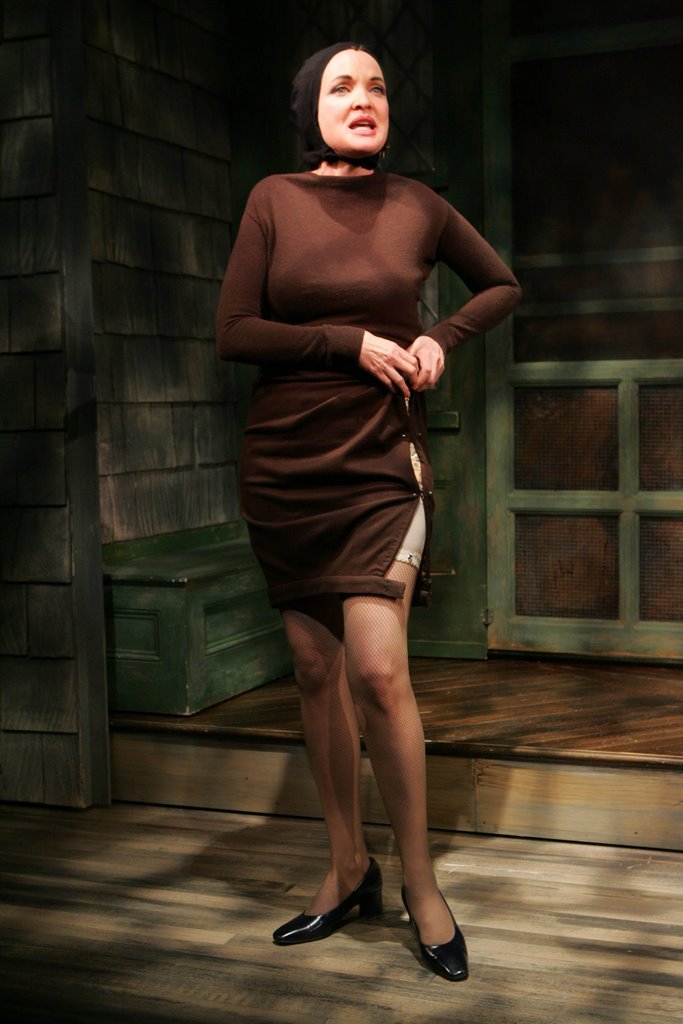
Ignore the poster, which looks like lesbian gymnastics performed atop a skull-shaped volcano. [It's below, for posterity.] And forget, for the moment, that its writer-director has modified its ending for its US release, which begins August 4 via Lionsgate. From web forums to the pages of Film Comment magazine, The Descent has been proclaimed as the scariest horror film to come down the pike in some time, and I'm not going to argue with that. I'm at an age where an increased lipid count or a decreasing bank balance upset me more than some movie boogeyman, and I rarely emerge from a horror film shaken anymore. [The true-life terror of United 93, or the paranoia-wracked atmosphere of A Scanner Darkly, still get under my skin.] Mileage will certainly vary as how alarming The Descent is. My guess is, given the basic, unnerving situation--female spelunkers, at odds with one another, versus unrelentingly vile humanoid "crawlers" in the claustrophobia of an unmapped cave--it will be a very intense hour-and-45-minutes for many. Scares aside, however, I admired the craft behind the film, which marks its British auteur, Neil Marshall, as a true classicist in a genre frequently given over to the jokiest, crassest exploitation.

Foreign-made horrors have a tough time on these shores. With the best intentions for the US audience, Lionsgate did more harm than good to the French-made Haute Tension, dubbing (ugh!) a movie that had more screams than chat-chat and cutting it back for an R-rating. The original edit is available on DVD, but the damage had been done. Marshall's first horror film, 2002's Dog Soldiers, premiered, between commercial breaks, on the Sci-Fi Channel, hardly an optimum venue. Amidst the ads, however, it was clear that Marshall was a cut above--the humdrum scenario, male military types going mano-a-paw with werewolves, was invigorated by reasonably somber telling and well-handled setpieces. The Descent continues in this vein, paring away the CGI, obvious scares, faux politicizing (as in the exploitative Hostel) and juvenile humor (a pox since the sequelizing of Freddy Krueger) that have settled like tumors on the form, and exposing the vital nerve endings.

Why does The Descent work as well as it does? For starters, it keeps the plot simple, and visual; action reveals character, and the emotions deepen without a lot of useless expository dialogue, as in The Texas Chain Saw Massacre, one movie that did work me over. The movie opens with a real jolt: The car accident deaths of the husband and daughter of Sarah (Shauna Macdonald, pictured above), following Sarah's annual extreme sports jaunts with her friends (in a reverse on Dog Soldiers, The Descent's leads are all female). A year later, Sarah, feeling nominally better but still haunted by visions of her dead child, agrees to join her gal pals on their latest adventure, exploring caverns. The group leader is Juno (Natalie Mendoza), Sarah's best friend--but, if you were paying attention to the first scene, it's clear that the friendship had ruptured, likely over infidelity on Juno's part with Sarah's husband. It's easy to miss this, as we're used to being spoon-fed rationales and explanations for behavior, but Marshall, in the tradition of the suggestive scenarios of Rosemary's Baby and Val Lewton (producer of the classic RKO chillers of the 40s, like Cat People and I Walked With a Zombie), doesn't dumb us down.


Within the caves (a beautiful series of sets designed by Simon Bowles, and imaginatively shot by Sam McCurdy), emotional fault lines develop. The movie is reminiscent of Deliverance in this regard but Marshall, to his credit, doesn't wear hommages on his sleeve. The bickering and in-fighting that develop leave the women (including Rebecca, played by Saskia Mulder, and Sam, played by MyAnna Buring, pictured) that much more defenseless when the monsters show up. Here again the movie is commendable, in that the creatures have been rendered prosthetically (by Paul Hyett), and not digitally, and move, and strike, credibly, rather than fantastically. Supported by an eerie soundscape that vibrates and hisses, you buy into the illusion. [Peter Jackson is one of the few filmmakers working in the CGI realm whose creations behave with some passing nod to the real world; see, or, rather, pass on seeing Van Helsing for the opposite.] In and of themselves, monsters aren't necessarily frightening; it's the buildup that gets you, and sustains you through the next twists in the storyline, and so it is with The Descent, in the tradition of Jawsand the very best creature features. Things get messy as the movie turns the screws, quite logically I found, but Marshall doesn't try to terrorize us with gore effects, which usually expose the limitations of the makeup artists (one exception is a horrific stalking sequence in the 1979 Zombie, a knockoff of Dawn of the Dead, but there, too, the mod is set up creaky, bump-in-the-night audio effects).


As it happens, I like the way The Descent ends. Lionsgate and Marshall need not apologize for trying it out here in the US. I don't think it's a cop-out, and not seeing it because it has an alternate conclusion is a clear instance of cutting off your nose to spite your face. The original ending may be more elegant, and more disturbingly symmetrical, but if the new one is a compromise at least it's a creative one. And it doesn't lead to speculation that all of this is happening in Sarah's tormented mind, which I don't buy. Marshall has made an excellent monster movie--if he believes in the existence of his monsters, so should we all.

[But, if you have to scratch that itch, the original ending is on the Region 2 DVD, which has made it toYouTube. Don't click till you've seen the film proper. It's worth seeing in the darkest recesses of your local bijou.]

Photos by Alex Bailey.

[By the way, this entry should push me above the 2,000-hit mark. Thanks for reading, and feel free to chime in.]

Thursday, July 27, 2006

Screen scene


Been too busy actually seeing movies to post much, but now it's time to pay the piper. Despite the skippability of so much--Lady in the Water, a no-hoper from the get-go and further proof that its auteur has lost whatever smarts he had left after the dreadful The Village, is already exiting my local cineplex, and for the first time ever I'm thumbing my nose at a Woody Allen film, which I should have done about a half-dozen credits or so; Match Point wasn't that good--the indie scene is fairly lively, and there are one or two decent movies in the malls, too. A look, with a French accent.


Clerks II (The Weinstein Company). Now in their early 30's, and at the point where extended adolescence congeals into a semi-permanent state, Dante (Brian O'Halloran) and Randal (Jeff Anderson)--well, Dante--ponder their options, this time behind the counter at a tacky fast-food chain. The references have changed--The Lord of the Rings and The Silence of the Lambs get a good going-over--but the scattershot, hit-and-miss format hasn't. Between gross-out gags involving "inter-species erotica" and cameo customers like Jason Lee, Ben Affleck, and the everywhere-all-at-once Wanda Sykes, writer-director Kevin Smith lets the sadness of resignation seep in, and the possibility of change, represented by pedicure-happy supervisor Becky (Rosario Dawson), who tests Dante's plans to relocate to Florida with girlfriend Emma (played by Smith's tough-as-fake nails wife Jennifer Schwalbach). The sequel is fortunate in the casually sexy Dawson, who, unlike the game but professionally amateurish O'Halloran and Anderson, has the skill to negotiate the shallower sections of the script. (Though Jay and Silent Bob can be counted on for their Mutt-and-Jeff act, the comedy honors are pretty much claimed by newcomer Trevor Fehrman, as Elias, an easily bamboozled fry cook, who is under the delusion that his girlfriend's virginity is guarded by trolls. His reaction shots are often funnier than the material, which may be how he got the job.) Confirming that a good ending can make up for a multitude of venal sins, however, Clerks II very deftly pulls itself together for a genuinely touching and warm-hearted conclusion, not an easy bar to reach after a leather-bound stud and his donkey have reached a different kind of climax. Maybe Smith, like Michael Apted and his "Up" documentaries, should revisit the Quick Stop every decade or so.


Edmond (First Independent Pictures). Mamet-land, where words, rather than fists, are thrown. Racial slurs that have very arguably been "reclaimed" by the popular culture still pack a wallop in an adaptation of his 1982 play, directed by his frequent stage collaborator, Stuart Gordon, one of the friendliest people I have ever interviewed. Gordon is best known for his two earliest films, the sprightly horrific Re-animator and From Beyond, and the visual shock effects here have jack-in-the-box jolt to them. But indie cinema has changed, and what took a modest cast and crew to pull off then today requires 20 producers of various kinds and a troupe of recognizable faces and/or names (Denise Richards, Bai Ling, Mena Suvari, Re-animator star Jeffrey Combs, etc.), whose brief appearances work against the anonymity of the seamy urban underbelly the self-loathing Edmond (William H. Macy, wired to combust) willfully rips into. Gripping (the mutually assured destruction between Macy and Julia Stiles, in one of the larger roles, and the very sly way Bokeem Woodbine plays a savior figure, especially), screwy (in its time- and place-warped way), and, depending on your taste, either content-rich or hopelessly impoverished. Given accomplished work (Bobby Johnston's jazz score and hard-edged lighting, by Denis Maloney, are also exemplary) I lean toward the former, but it's hard to imagine wanting to spend another 82 minutes in Edmond's disagreeable company to confirm my opinion. By the way, I held onto my From Beyond promotional souvenir hat, with its grotesque pop-out "third eye," for many years, and wonder what I could get for it on eBay.


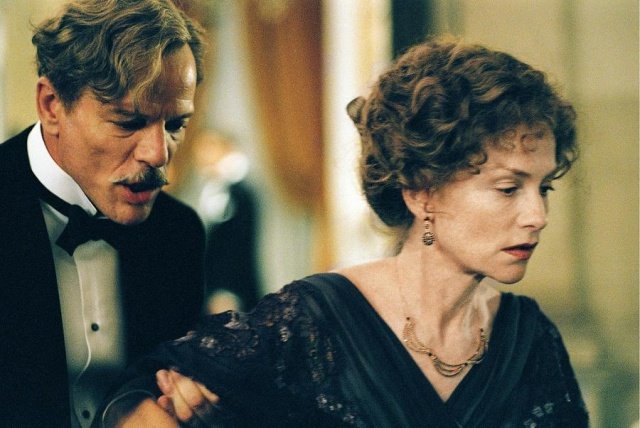
Gabrielle (IFC Films). Infidelity is a theme of this Joseph Conrad adaptation. Alas, the director and co-writer, Patrice Chereau, follows suit by breaking faith with the material, introducing grating, inappropriate music and flashing words like giant text nessages across the screen, as if he distrusted its ability to hold an audience's attention. Wrong. Isabelle Huppert, who as always acts as if some strange force has entered her body and is trying to exert full control through her intense eyes (I mean this as a compliment; she is stunning in a remote way I cannot comprehend after 30 years of immaculate performances) is Gabrielle, who after 10 years has walked out on her marriage to the stuffy, pompous, stifling Jean (Pascal Greggory, with a manner like a vise)--the trouble really starts when she just as abruptly walks back in, setting off tremors that extend beyond their chilly relationship to their 19th century social circle. I was captivated, by the psychological warfare waged by the two leads (both faultless) and Eric Gautier's slightly smudgy cinematography, which removes the Merchant-Ivory-ish gloss off the formally appointed parlors and bedrooms, and resented Chereau's juvenile intrusions. If only Chereau (who made my favorite historical drama of recent years, 1994's Queen Margot, but has been otherwise erratic) had dared to be unhip and made a true chamber piece, one that sucks the air right out of the theater and leaves you gasping after 90 minutes. Movies like this should kill you.


Heading South (Shadow Distribution Inc.). Laurent Cantet's followup to his excellent films about working life, Human Resources and Time Out, has been misread. It is a continuation, and not a departure, from those movies, moving from the office to a hazier, but no less entrenched, economy where gifts and money are traded for sex. And, much as a recent, well-intentioned New York Times Style section piece tried to turn it into some sort of sizzler about older women and younger lovers, Heading South is no day at the beach; if anything, it's cold water thrown at the likes of How Stella Got Her Groove Back (whose author eventually found out, the hard way, about the limits to frolicking with toy boys who turn out to have minds, and inclinations, of their own). There is a little May-October nudity and hanky panky, but much of the mutual seduction is a matter of hands playing lightly across backs, and business being transacted from white to black hands just as discreetly. The film is at its most absorbing when it shows how each of the participants in these games of fantasy and commerce, including queen bee Ellen (a cattier, chattier Charlotte Rampling than usual), the searching Brenda (Karen Young, excellent even in a difficult, romance novel-type monologue), thrill-seeker Sue (Louise Portal), and lust object Legba (Menothy Cesar), get something from the deal; less so in blaming "American dollars" for the corruption that annihilates the playground that Haiti's beaches seemed to be in the mid-1970s. [Dumping its ills entirely on North America isn't going to solve its ongoing plight; as it was, the filmmakers were forced to decamp to Santo Domingo when local conditions worsened.] The politics, like the sex and the yearning that underlies it, might have better served behind closed doors, but Heading South is a more thoughtful, much less empty-headed piece than I had been lead to believe from the largely dismissive reviews.

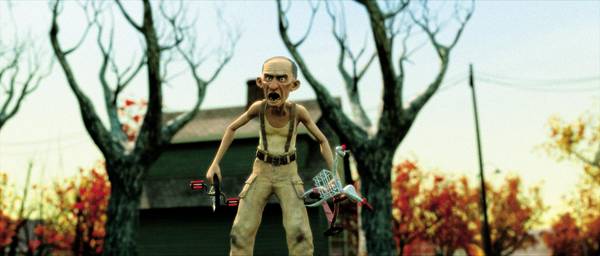
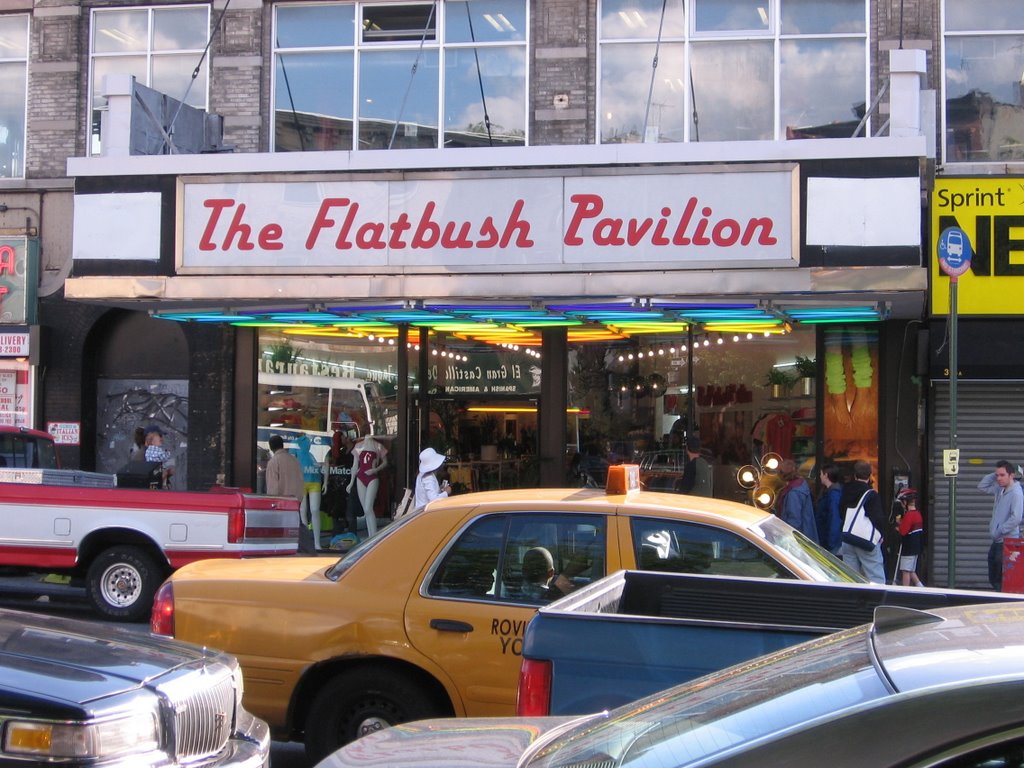
Monster House (Columbia). I'm so over the digitally animated adventures of talking cars, animals, and bugs, but a monster house possessed by the spirit of a rumbling and growling Kathleen Turner, that uproots itself to chase screaming little kids around the block, and in 3D no less in select theaters (Brooklyn's Flatbush Pavilion has a superb set-up)...well, I am so there. I've been fascinated by 3D since my parents took me to see the revival of 1953's House of Wax in 1982, which kicked off a brief revival of the format and movies like Friday the 13th Part III and Jaws 3-D, all of which I donned glasses for. The third dimension has made a comeback recently, with Monster House the second feature to extend executive producer Robert Zemeckis' motion capture photography effects (as seen in The Polar Express) to the realm of flying objects. But the best 3D is more than that, and Monster House also uses the format more subtly, to create an immersive, tactile world. The story--kids, a little less doll-like than in Express, trying to find out the secret of that people-eating house and its grouchy owner (cantakerously voiced by Steve Buscemi)--is slight, but felt, with a feel for how gawky preadolescents talk and relate (the movie pushes against its PG rating, a reminder of what that rating was before the more restrictive PG-13 was introduced in 1984). I'd call the action overly derivative of executive producer Steven Spielberg if only I weren't pleased to find someone (debut director Gil Kenan) working in that classical style, one largely abandoned for gobs of frenetically edited CGI. Not a big deal, but a pleasant summer breeze. A motion-captured Maggie Gyllenhaal is very funny as an insolent babysitter, prime house bait. Sign me up for this Halloween's revival of Tim Burton's The Nightmare Before Christmas, reworked for 3D.


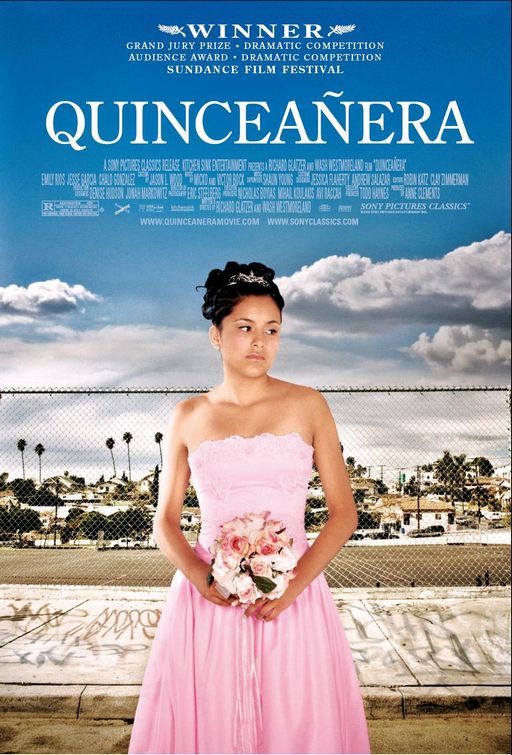
Quiceanera (Sony Pictures Classics; opens August 4). A Mexican-American girl's 15th birthday, a major celebration, touches off family strife, and reconciliation, in this Sundance hit, which co-writers and -directors Richard Glatzer and Wash Westmoreland patterned after the kitchen sink dramas produced in England in the late 1950's and early '60s. But the Echo Park neighborhood in Los Angeles where the filmmakers live, and shot the movie, is no drab flatlands of council flats, and Eric Steelberg's assured digital cinematography bursts with color. The storyline, in which celebrant Magdalena (Emily Rios) finds herself with child in an apparent virgin birth, strains the purported realism. More down-to-earth is her affection for her great-great uncle Tomas (a lovely performance by Sam Peckinpah veteran Chalo Gonzalez), who she lives with after being kicked out by her father, and the Heading South-type interaction of her fellow castaway, gay cousin Carlos (Jesse Garcia), with the homosexual landowners of Tomas' modest, but cheerily gardened, rental house. Without condescending, the filmmakers behind 2001's The Fluffer, a dreamy Boogie Nights drama set in the world of gay porn (where Westmoreland learned his trade), alight on a more affectionately observed community, which returns the favor by opening itself up to us.

Der Fur-rers


Where do people come up with this stuff...have to admit, though, we saw a genuine "Kitler" roaming a parking lot near us. Boys from Brazil-style, they're multiplying...are Picque (left) and Tom-Yum (right) enjoying a cute moment, or locked in conspiracy?

Friday, July 14, 2006

Speak of THE DEVIL


In a recent topic discussion, the usually civilized Mobius Home Video Forum got hot and bothered over HBO's Sex and the City, which departed pay cable two years ago but now reaches a wider audience via edited versions broadcast on TBS. As someone who absolutely hates formulaic cop, doctor, and lawyer shows (on principle, I've never seen a complete episode of any of the Law & Order franchise members), I found Sex a pleasant break from the programming paradigm, and without its success HBO might never have pursued other breakthroughs, like The Sopranos and the very best show on TV, Deadwood, the weekly equivalent of great literature in broadcast form. Given that Mobius has few female members (or, maybe, few female members with an interest in the subject at hand), I can't say the conversation broke down along gender lines, but it certainly broke apart, and I found myself the last man standing defending the show against charges of tastelessness, inaccuracy, and the perceived unattractiveness of its castmembers (a low blow, that one).

I see Sex and the City, and now The Devil Wears Prada (which share a director, David Frankel, and the sublime costume designer, Patricia Field) as the natural extensions of traditional "women's pictures," a genre that has much to offer straight men (gay men so get them), if only they'd look beyond, I don't know, ESPN or The Speed Channel (OK, I'm stereotyping). I got into them, naturally, from horror movies, specifically those battleaxe titles from the Sixties, like What Ever Happened to Baby Jane? (1962) and Strait-Jacket (1964), featuring Joan Crawford and Bette Davis in their last, campy hurrahs as screen stars. In turn, I sought out their cornerstone titles, and became an unabashed fan. The direction and screenwriting may have been the work of men, but the emotions and temperament were exquisitely, savagely, funnily female. They helped open my eyes to the mysteries of the opposite sex, much as key films like Kramer vs. Kramer and Raging Bull, for example, offered insight into the world of adults, so near and yet so far away from my teenage consciousness.

Sex and The Devil (there's a movie title for you) update The Best of Everything (1959), a Crawford co-starrer based on Rona Jaffe's highly influential novel, with a scoop of Doris Day's hugely popular comedies from the same era added on top. (The Day comedies are weirdly unfunny today--the humor in 2003's warmly parodic Down With Love is much more au courant--but the social gleanings are as fascinating as examining the rings of an ancient redwood tree). All are set in "glamorous" New York City working worlds. For all their seductiveness, these are unmasked as quietly seething snakepits of clashing egos and petty misbehavior, where the rise to the top is accompanied by a corresponding solitude and loneliness, the high price to be paid for mastery of the universe. In the older models, the nice girl, pushed too far by a tyrannical boss, either walks away, for the security of family life, or grimly accepts what will be her lot in life by climbing the treacherous rungs of the career ladder. The newer films and TV shows, which give women freer rein over their personal and professional lives (which undoubtedly bugs more conservative male and female viewers) aren't so cut-and-dried in their choices.


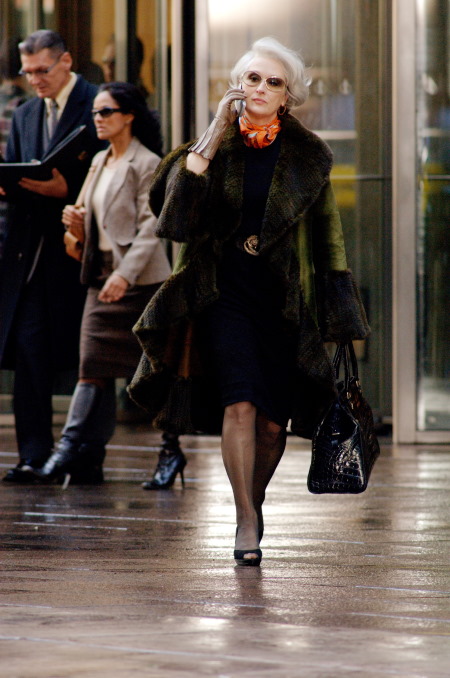
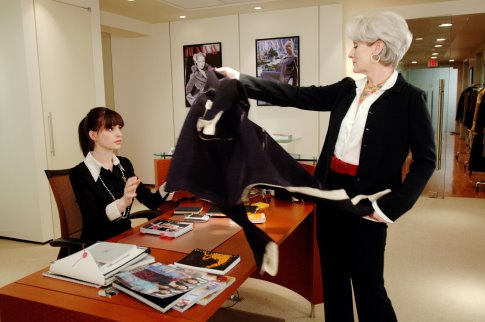
The pre-9/11 episodes of Sex very accurately reflect the sense of New York City as party central in the mid- to late Nineties, days of wine and roses when new possibilities seemed to be falling from the skyscrapers. The show changed smartly with the times, and the current hangover is reflected in The Devil Wears Prada, based on Lauren Weisberger's bestseller, a book that helped define "chick-lit." I haven't read it (there are limits to my interest in the world of women), but by all accounts the screenplay, by Aline Brosh McKenna, adjusts the hemline of the novel, which was an assistant's screed against her nasty, flagrantly self-serving employer, who among other slights and eccentricities never bothered to say "please" and "thank you" when she flung her expensive coats on said assistant's desk in the morning. That's all in the movie, encapsulated in an amusing montage of couture in motion (pictured). And I assume the weak, perfunctory sequences of the assistant's social life and boyfriend problems (the guys are played by Adrian Grenier, star of HBO's Entourage, a male response to Sex and the City, and Simon Baker, with eyebrows and facial hair that suggest a passing-for-chic blond werewolf), come from the book, too. Like its predecessors, it's not a deep probe into the politics of the workplace, but like good pop culture it has at least one ear to the ground regarding its subject.


But the master-and-servant games are exceedingly well-played, by Anne Hathaway, Stanley Tucci and Emily Blunt on the one side of the fence, and a wicked Meryl Streep on the other. The template requires that the identification figure, Hathaway's Andy, be naive, but maybe not so much as here; while I appreciated the switch in Andy's alma mater from the book's Brown to Northwestern's J-school (my own; did they pay someone for the actress to wear one of the signature purple-and-white sweatshirts?), she's a little dense on basic j-job interview prep--no self-respecting NU grad would not know that Runway is the leading fashion magazine, and that its editor-in-chief, the imperious Miranda Priestly, is, as her name implies, the high priestess of that domain. I was a little insulted, but it's a 109-minute movie and the exposition has to be gotten through on the run, delivered by Miranda's first assistant, Emily (Blunt), who is incredulous at how much of a bumpkin, in attitude and attire, Andy is. But, as impressed as someone of her status can be by an underling with Andy's promises of a solid work ethic, Miranda hires her anyway to be her second assistant.

The movie is very shrewd in its portrayal of Miranda. We come to see that she has an inner life, beneath her frosty surface, and there is a replay of the familiar (but always gripping) scene where she lets her fabulously tended hair and makeup slip in the presence of her new confidante, Andy, who is by this time less recognizable as the naive liberal girl we met in the beginning. But we only see her at a remove, in the context on her employees, who are awed, cowed, and shaped by her. (The movie would be silly if Miranda barnstormed through as its central character. And, in a credible real-life touch, Miranda's unassailable reputation does not make her wholly invincible from the front-office beancounters.) Miranda, who like a practiced Mafia don of yore strikes more terror with a raised eyebrow than a raised voice, is not a stereotypical boss-from-hell--there is a method to her pettiness, which the starstruck (and, ultimately, struck down) Emily never sees. When she comes down hard on a tearful Andy, we see that Miranda is right for doing so; as her sage second-in-command, gay-man-in-waiting, Nigel (Tucci) observes, Andy broke faith, by not living up to her initial promise and condescending to the job at hand. In the real world, Andy would be speed dialing for her unemployment benefits by this time but Nigel, with some reluctance, opens the door for her to Runway's promised land of cast-off clothes, enabling Andy to get a better wardrobe and a better attitude.


From here on in, Miranda, rather than be awed by the new, improved Andy, continually ratchets the stakes, forcing Andy to complete even more impossible tasks and putting her on difficult moral territory regarding Emily, who has fallen behind in the placating sweepstakes. Here is where the old and new-model women's pictures part ways. Yesteryear, Andy would have walked out of the office, as if the experience had never happened, and into the arms of her waiting beau. But here, Andy (who, in another switch from the template, has her cake and eats it too regarding Boyfriend No. 2, Baker's smarmily charming freelancer) actually learns something of value once the gamesplaying reaches a crucial peak--Emily and Nigel, who will have to live in hope longer than anticipated, will have to keep playing. Andy's character is reassembled, toughened up for meaner streets than Carrie and the gang walked on Sex and the City. Miranda's final (and, in the picture, only) enigmatic smile, the one private moment she is allowed, is her savoring that someone (an NU grad!) finally understood the down-and-dirty lessons she was trying to impart. (Or maybe it's an awareness that Andy's next environment is even more ego-driven than the one she exited, in a more dressed-down way. Or maybe she's put one over on Andy; "she's smart, but if only she had thrown her coat on her desk one morning, or put down my dress sense, I would have laughed and my whole house of cards would have finally collapsed." However you read it, it's another comedy triumph for Streep, right up there with Death Becomes Herand Adaptation. She's truly in clover now, and as finely aged as vintage wine, with a Mother Courage due in Central Park that will be something to see.)

Not a great film, The Devil Wears Prada is nevertheless, and obviously, very bloggable, for more besides its shoes and belts. It opens a corner office window on the here-and-now regarding timeless subjects in the movies and in life. And, guys, I gotta tell you--reliable sources say the gift of the year, available now in stores, is among Andy's accessories, and by not seeing The Devil there'll be hell to pay regarding your significant other when you come up empty this Christmas.

Saturday, July 08, 2006

On the beach


The best vacations yield time--and, for me, that's time to read books. (I read plenty of magazines, newspapers, and web journals--maybe too many--during the course of a typical week.) I generally read histories and biographies, with an occasional novel thrown into the mix, but I find that movies and TV usually take care of my need for fiction. So I lugged a few tomes into my backpack and plunked myself down at my in-laws' Lake Michigan house in Oostburg, WI, where--between sweeping the beach of dead alewives, dips into the sometimes frigid water (not too much of a problem for an Atlantic Ocean hand like myself) plundering the local strawberry patch, and enjoying a Wisconsin diet of cheese curds, bratwurst, and local Leinenkugel's beer--I cracked open a few biographies.

What turned out to be the disappointment of the bunch, Jon Krampner's Female Brando: The Legend of Kim Stanley (Backstage Books), was up first. Krampner has a fascinatingly elusive subject in his grasp, the much-acclaimed actress who tore up Broadway and live television with her no-holds-barred performances in the 1950s, but who was largely spent by the mid-1960s, never to return to the stage after a disastrous Actors Studio Theater production of The Three Sisters on the West End in 1965. (A handful of TV appearances, mostly with theater acquaintances who tolerated her eccentricities, like Jack Klugman, and her Oscar-nominated turn in 1982's Frances, followed by her vivid aviator barkeep Pancho Barnes in The Right Stuff and a good Big Mama in a cable Cat on a Hot Tin Roof, were about the extent of her later output; I was interested to read that she starred in an episode of Rod Serling's Night Gallery and will have to look for it.)

But the author never quite gets a handle on Stanley, which in itself is unsurprising. The many people interviewed for the book seem perplexed by her shaman-like ability to conjure fully lived-in characters, from material ranging from good (her stage triumphs in William Inge's Picnic and Bus Stop, which Marilyn Monroe, who Stanley liked, freely borrowed for the 1956 film) to pedestrian or unpromising on the page, and create astonishing performances night after night...or, those nights she could pull herself together in time for to go on, a constant, career-stunting problem, aggravated by her legendary, lonely drinking. (The grislier episodes Krampner recounts are unpleasant to read.) Stanley was a born actress--from an early age, the New Mexico-born performer pretended to be a more sophisticated Texan, and besides a score of later evasions and half-truths she enacted with producers and colleagues she whipped up domestic drama besides. Her three children remember her graciously, if cautiously, whatever games she played with their true paternity, which she hid. For her, acting was everything; she disdained performers like Julie Harris, who "had it all worked out before they set foot on the stage." (Surprisingly, Harris supplies a warm back jacket quote.) But it was a constantly changing false front she maintained with quarts of alcohol; when it gave out, she taught the craft, as best she could under declining circumstances (friends like Gregory Peck footed the bills), in haphazardly scheduled all-night marathons that amazed students like future L.A. Law star Alan Rachins.

With so much promising material, why isn't this book better? The torn-from-Variety title doesn't help (Brando, who exited the stage early on and never set foot on live TV as I can recall, isn't an apt comparison; Stanley, Krampner says, preferred those mediums as they left no trace, nothing to torment her with her presumed mistakes and errors in editorial judgment, as her four movies did, including the best of them, 1964's Seance on a Wet Afternoon). Nor does the author's insistence on calling his subject "Kim," a fanboy affectation. And there are curious paragraphs where Krampner, highlighting an important moment in Stanley's career, brings in other historical events of the day, as if they were of somehow equal importance. (The forgotten 1960 play Taffy doesn't quite stack up to the U-2 spying incident.) His subject never wanted to be caught acting, but Krampner is frequently caught writing, trying to breathe imaginative life to his no-bottle-unturned research. Female Brando (writing it, I think again, what a dumb, name-dropping, title!) is a necessary book, but it does not rise to the standards of its subject.

If you read enough of these books in succession, patterns form. George C. Scott was in that storm-tossed production of The Three Sisters, at the same time he and one of the loveliest of the screen's love goddesses, Ava Gardner, the subject of Lee Server's Ava Gardner: "Love is Nothing" (St. Martin's Press) were in the middle of their own tempestuous relationship. You wonder: Did Stanley and Gardner meet? Did they talk about stealing husbands and boyfriends from Shelley Winters, who stole them right back? Their erratic on-set behavior? And: What did they drink?

For Gardner, like Stanley, was one of the acting world's great imbibers, with an intake so legendary it alarmed even the subject of Server's last Hollywood bio, Robert Mitchum, who hot-footed it from her company when he was trying to stay on the wagon. Gardner tended bar better than she did her fairly careless career. Audiences, alas, perhaps remember her best from her blowsy, clingly turn in the smash hit Earthquake than they do her steely temptress in 1946's The Killers, her breakthrough role; her rowdier, Oscar-nominated performance opposite her childhood idol Clark Gable in John Ford's Mogambo(1953), closer to her actual self than the period pictures she was so often embalmed in; and her more nuanced work in the talky, unsatisfying (except to Truffaut and Godard and the Cahiers du Cinema staff) The Barefoot Countessa and George Cukor's severely shorn Bhowani Junction, both 1954. (This entry's title plays off of one of her better parts, if not better pictures.) Her scandal-sheet press clippings far outnumbered her critical notices, not that she had much faith in her acting ability anyway, and some of the best ("What Makes Ava Gardner Run for Sammy Davis, Jr.?" asked Confidential) make up a full spread of this book's illustrations. Her misadventures with her three husbands (the cagey, horny Mickey Rooney, the misanthropic Artie Shaw, and the impossible Frank Sinatra), and numerous romances with the unbalanced Howard Hughes, lesser lights, and bullfighters kept the tabloids hopping for two-and-a-half decades, and Server diligently keeps tabs on the bar bills and court hearings. (Almost too much so; as with the Stanley bio, a little discretion, and tighter editing, would not have interfered with the facts.)

A noir-ish prose stylist, Server finds words that correlate nicely with the what-the-hell outlook of his blown-sideways-through-life subject, who based on her ineffable beauty made a near-impossible leap from hard-scrabble North Carolina to the pillars of Hollywood at an impressionable age; the men in her personal and professional life, from Louis B. Mayer to Fidel Castro (an almost bedmate, shortly after the revolution, during her Spanish phase in partners) are tangily rendered. There are a few problems with the text: Basic copyediting errors, which crop up more and more in these books as that function is slighted (Paul "Lucas" for "Lukas"), and questionable assertions--Henry King may have stumbled with his Gardner assignments, but the director of The Gunfighter and Twelve O'Clock High was no throwback to the silent era, as Server mocks him. And I was surprised to find no mention of the 1954 Oscar ceremony; surely she had made an appearance or had some public reaction to being nominated?

This is, however, an irresistible volume, and as the ridiculously complicated chapter with the supremely volatile Scott comes to a close, you can imagine Gardner thinking the thoughts Server puts in her head: "She would never understand it. Love was supposed to be such a wonderful thing. How could it cause so much unhappiness? Why did love always have to mean a broken collarbone, 50ccs of phenobarbitol, and somebody fleeing in the night?"

I'm currently finishing up Kenneth D. Ackerman's Boss Tweed, a superb biography of New York's legendary king of graft. My reading coincided, of course, with the death of today's Tweed, Enron's Kenneth Lay, who, unlike his predecessor in crime, left no Brooklyn Bridge or Central Park behind as the money sloshed in and out of Houston. Death robbed Lay of any chance of clearing his "good name" through further court action, which is satisfying in its own way.


On one of the iffier weather days we went off to Smallville-like Sheboygan to see Superman Returns, already last week's hit in the wake of the second Pirates picture. I replied to a blog entry about it at The House Next Door and don't have much to add, except that I look forward to seeing it again, flaws and all, in Imax 3D. Not an origins story, but a remake of an origins story told as a semi-sequel, it's naturally an odd film, with a muffled beginning and ending (surely Kevin Spacey's Lex Luthor deserved a more fitting send-off?). And those swooping, 1978-styled credits really don't work when your stars are nobodies like Sam Huntington and Kal Penn and not Marlon Brando and Gene Hackman. Money spent, I wonder if director Bryan Singer now realizes that it needed to be more of its own thing and less of an homage, however gorgeously rendered. But no one could say "Great Caesar's ghost!" with the aplomb of Frank Langella, not even Jackie Cooper, and it's those elements, which are exactly right, that can stand a revisit. But no "Leinies" afterwards, next time.

Saturday, June 24, 2006

Drug culture


I won't be waiting on line to see the much-touted PIRATES OF THE CARIBBEAN sequel. Why the cult that had been gathering for years around its star, Johnny Depp, exploded around the first one I'll never fathom. It was, to me, a spoofy, HUDSON HAWK-ish swashbuckler with the usual after-thought script and tinsel production values associated with producer Jerry Bruckheimer, and my eyelids were in full flutter during the press screening. I figured it a cinch for Davy Jones' locker, but audiences and Oscar nominators found Depp's scruffy pirate adorable, and maybe there was some pent-up demand for swashbucklers I had missed (Manhattan's Film Forum has a bunch of good ones scheduled for August). And now there are not one, but two, sequels sighted, the first with undead fish people pirates. I don't know what to think. I was the one caught napping the first time, but maybe my brethren will wake up this time and realize how truly dopey this all is (or, hey, maybe it'll actually be good...).

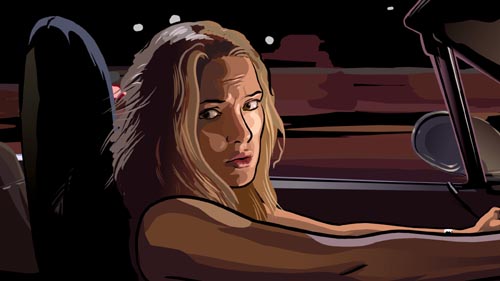
Opening the same day (July 7), with less fanfare and on far fewer screens, is the antidote, Richard Linklater's superior adaptation of Philip K. Dick's A SCANNER DARKLY (Warner Independent Pictures), easily one of the best films of the year. Linklater, a staunch indie filmmaker, had become a cause for concern. I couldn't begrudge him his success with SCHOOL OF ROCK, as lightweight and forgettable as any Jack Black vehicle, but last summer's BAD NEWS BEARS was a shockingly lazy remake, a completely phoned-in assignment that suggested a distressed cynicism on the filmmaker's part. I know he had written and directed SLACKER but this was taking slacking a bit too far, and the creator of DAZED AND CONFUSED, BEFORE SUNRISE and BEFORE SUNSET seemed unsettlingly adrift. Not so with A SCANNER DARKLY, which manages, amazingly, to be faithful to its author's intentions while being fully Linklater besides*.

What unifies the film is its form---like Linklater's trippily philosophical WAKING LIFE (2001), A SCANNER DARKLY was shot live, then animated via rotoscoping techniques that designer Bob Sabiston has refined for the new film. Given its rootless content, WAKING LIFE was appropriately jittery and twitchy, but I know some viewers didn't cotton to what was like looking into a faster-moving lava lamp for 100 minutes. With one notable exception, A SCANNER DARKLY is more "solid," though it, too, has an unmoored feeling; cars and roads, for example, seem to exist on slightly separate planes. But this isn't a showoffy gimmick; thanks to Substance D, a drug that has 20% of the U.S. population hooked seven years hence in the world of the film, consciousness has been altered, and everyone, from the afflicted to the drug czars, is swimming in in its after-effects and consequences. Everything looks the same but nothing looks quite right.

Animation solves the biggest problem afflicting adaptations of Dick's work, many of which I've enjoyed at least in part (except John Woo's PAYCHECK, the title of Dick's story and the reason why anyone seemed to be making the movie). They establish a bleak, noirish premise and a similar mood, which is instantly disrupted when a mechanical effect, CGI creature, or chase scene is introduced. Dick's tough-minded prose handles all this with ease (assuming the robots, monsters, and pursuits were his inventions and not the vamping of a screenwriter trying to flesh out his sometimes very short stories) but live-action movies like TOTAL RECALL and MINORITY REPORT have a harder time of it, eventually giving into black comedy gags or reassuring sentiment. (The very "phildickian" BATTLESTAR GALACTICA TV show has, admirably, absorbed the tone without compromising or sentimentalizing typical Dick themes of alienation and paranoia). But animation is already unreal to our eyes, and more readily assimilates the wilder notions of the plotline, including a hectoring, thousand-eyed sentinel at the doorway to the afterlife, characters who casually sprout insect features, and, at the very start, an itchy infestation of aphids that a D addict has, or has not, hallucinated. This "cool stuff," which would be showstoppingly achieved in an expensive feature film, is here part of the show, and not the show itself. A SCANNER DARKLY was drawn from Dick's own experiences with drugs, visions, and paranoia, and the form honors and respects its source.

Rotoscoping realization also makes Keanu Reeves, so coolly "perfect" in THE MATRIX movies, a little more human. I was initially put off by his flat line readings, but came to see this as an asset; his character, Robert Arctor, is trying to keep his bearings, and his balance, in a tricky situation. A suburban dropout who has landed in Anaheim, CA, Arctor spends some of his day in a rundown household he shares with his D-dropping buddies, Barris (Robert Downey, Jr.) and Luckman (Woody Harrelson). Freck (Rory Cochrane), who is on the verge of D psychosis, and Arctor's sort-of girlfriend, Donna (Winona Ryder, a welcome presence even in facsimile form), also drop by, for some of Linklater's hilariously cockeyed conversations on the meaning of life as argued by people who live life in the grip of highly questionable stimulants. (Downey, Jr. and Harrelson could probably string this kind of material along all day long and score with it, over and over again). As part of his job, Arctor takes D, too--what his comrades don't know is that he works as an undercover narcotics agent, sniffing out D users and their supplier networks.


What Arctor doesn't know is that maybe his friends do know about his spying; Donna, an admitted cokehead who works, ironically, in surveillance, scanning the movements of suspects, is almost certainly onto him, but may not be his greatest threat to his double life. His own growing infatuation with D may be his undoing, as his bosses plumb his involvement with the drug. Not that they can see him--in the one flickering effect I had mentioned, Arctor wears a disguising "scramble suit," which constantly shifts identities, to the office, and to pro-drug war functions like booster club meetings, to maintain his cover. Industrial Light & Magic would have had a field day with this thing, but in the animated world it's just part of the fabric, as the film deepens into a multifaceted commentary on, and critique of, drug taking, drug laws, and recovery. The coda--a recounting, by Dick, of his own losses to drugs, is quietly shattering.

But I wasn't just moved by A SCANNER DARKLY. For a few hours after I saw it, I actually caught it. Minor encounters with people on the subway seemed slightly heightened. I felt hesitant and unsure with people I knew, tinged, just a touch, with suspicion, but also a little more open to the encounter. I can't explain it; it wasn't unpleasant, it just was. How will I feel on a second viewing? All I can say is that my first impression of A SCANNER DARKLY was unexpectedly transforming. Movies as rich as this can be habit-forming.

More on Dick, the film, and the source material, here. And find out how Dick, gone many years, lost his head in service of this film. I hope for a safe recovery.

*Reliable sources tell me that Linklater's other adaptation this year, of the best-seller FAST FOOD NATION, isn't as potent, but this is a startlingly ambitious couple of films. If making BAD NEWS BEARS helped cleanse his palate for them, maybe it's not so distasteful.

Wednesday, June 21, 2006

Summer indies


With SUPERMAN RETURNS and THE DEVIL WEARS PRADA winging their way into theaters, aloft on advance praise, there might be hope yet for the most dismal Hollywood summer on record. [I've never skipped so much, ever.] SPIDER-MAN 3 is shooting in my neighborhood, around Smith and Court Sts., so maybe Brooklyn will bring good luck for a better crop next year.

Meanwhile, the independent market is hopping, if only in the number of releases; regarding attendance, they're hobbling. But it would be a shame to relegate THE HIDDEN BLADE (Tartan Films), easily one of the best films of this year (or, for that matter, 2004, when it was released in Japan), to your Netflix queue.

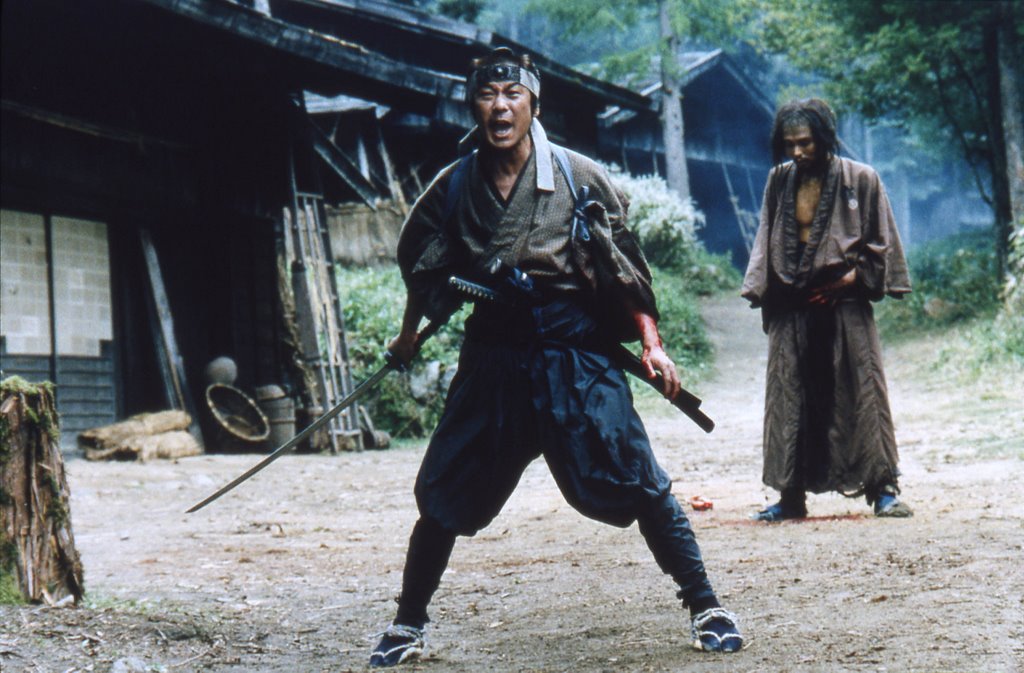
As it happens, I saw it on a screener DVD. Impressive there, I can only imagine how much more I'd be taken with it at a theater. Since Film Forum of New York's dazzling "Summer Samurai" series last year I've gone a little samurai-happy; SAMURAI REBELLION, the cornerstone of that festival (now on DVD from Criterion) was a sensational film, and I've seen several since. THE HIDDEN BLADE is kith and kin to the very best recent samurai film, no, not the pre-breakdown Tom Cruise's LAST SAMURAI, but 2002's THE TWILIGHT SAMURAI, an international hit that received a subsequent release here. At age 71, its writer-director, Yoji Yamada, was an overnight sensation, and THE TWILIGHT SAMURAI, which swept the Awards of the Japanese Academy, went on to receive a Best Foreign Language Film Oscar nomination in 2004.

Yamada was hardly an unknown quantity; indeed, his stewardship of the wildly popular Tora-san films, detailing the gentle misadventures of an ordinary salesman, made him one of the country's most successful directors. But samurai travel better than salarymen. I've not seen a Tora-san film, but the qualities ascribed to them--their quiet, becoming modesty, credible, character-based humor, and affection for individuals stuck at the bottom rungs of society's ladder--were surely the reasons the two otherwise very different samurai movies have met with so much success. It's not their wall-to-wall action; samurai film fans know that the best of these films are coiled tight, with the screws turning subtly throughout, till the final, explosive release. The blade in THE HIDDEN BLADE is hidden for so long you may well forget about it, but when it's finally, devastatingly drawn, look out.

THE HIDDEN BLADE stars Masatoshi Nagase, who you may remember as one of the Elvis-struck Memphis visitors in Jim Jarmusch's MYSTERY TRAIN (1989). Nagase has played a comical detective in a popular movie series since then, and I was surprised to see how well the 19th century samurai code fit him after so much onscreen slacking off. His character, Munezo Katagiri, has sharp instincts undulled from the onset of middle age, but his loyalty to the code is doubly tested, when his clan obligates him to kill a trouble-making older comrade, and when his secret love for a former housekeeper, Kie (actress and pop star Takako Matsu, warmly sympathetic), is severely tested.

The mood, which grows ever more taut over the course of the film's exceedingly well-paced 132 minutes, is splendidly sustained, as one man's allegiance to all he holds sacred begins to waver in the face of changing mores. There are, for example, some funny scenes involving a changeover to Western-style artillery, handled more offhandedly than in the Cruise film. What's smartest about THE HIDDEN BLADE is its economy of production, which is just the right size and convincingly, not overelaborately detailed, and austerity of emotion. Nothing is wasted; everything is conserved, and purposeful, as the film moves inexorably to its conclusion. It's a gem, heartily recommended. And, more good news, Yamada, 75 this year, is making another samurai film.


A picture is worth a thousand words, so the moving pictures of THE ROAD TO GUANTANAMO (Roadside Attractions) must be priceless. It's one thing to read about the sorry state of affairs at this outpost of the "war on terror"; another to see still photos; and quite another entirely to see the confinement and imprisonment enacted, documentary-style. Even this modest photo is unsettling, like something from a sci-fi film, suggesting captivity on Mars. But it's going on in the here and now, in Cuba, with no end in sight as a black mark against the American and British allies continues to widen, like a stain.

The film dramatizes the odyssey of the "Tipton Three," British citizens who, while attending a wedding in Pakistan, crossed into Afghanistan to deliver humanitarian aid as the U.S. began bombing the Taliban. The action is conveyed matter-of-factly, in the manner of co-director Michael Winterbottom's harrowing immigrant saga IN THIS WORLD, and intercut with comments from the actual men. Missing, however, is the rationale, the specifics, of what drew these young, Gap- and Adidas-clad men into the vortex of war in the immediate aftermath of 9/11, and the matter of their past brushes with the law is briskly eluded. Lacking context (the film, co-directed by Mat Whitecross, has no credited screenwriter), I couldn't help but feel that these men were guilty of something, if only incredibly bad judgment as what can be seen one good thing to come out of the war to date (the dismantling of the wretched Taliban regime) came to pass before their eyes.

Were they collaborators? Terrorists-in-the-making? Unclear. But did their punishment, meted out once they were captured by Northern Alliance forces and locked in metal containers, then sent onto the Guantanamo camps for two years without charges, fit the crime? Clearly not, argue the filmmakers, and their evidence is persuasive. This is not the glamorous, James Bond-like fortress Gitmo of BAD BOYS 2, or even the more by-the-book A FEW GOOD MEN, but a squalid, grubby place, where the prisoners are confined in outdoor cages and routine torture and interrogation is the norm, and the only tender mercy is when an officer snuffs out a tarantula that has sneaked into a cell. That, and a surrealistic celebration that breaks out when the young men, nearing the light at the end of a very long tunnel, are treated to Pizza Hut and McDonald's by their captors.

The cinema verite work by the cast and crew, led by the inexhaustible Winterbottom (six films, different from one another, in three years), is nothing sort of astonishing. You are there, in the shoes of the reenactors, in Pakistan and Afghanistan, as their story develops. (Filming also took place in Iran, where Gitmo was recreated--read into that what you'd like.) It's satisfying on a purely physical level, however insufficiently the drama is developed. (IN THE NAME OF THE FATHER may the best attempt to make a film of this type without the trappings of documentary.)The second half of the 95-minute film is a seemingly endless round of badgering, dirty tricks, and abuse, that you'd like to turn away from.

But don't, whatever questions you might have about what brought Asif, Shafiq, and Ruhel into this heart of darkness in the first place. Is this ROAD where a truly national conversation, beyond the bullet points and talking heads, about Gitmo begins? I'd like to think so, but that will mean commitment on the part of Roadside to ensure adequate distribution and a filmgoing public willing to engage it.


When did movie comedy get so ugly to look at? It wasn't always so; the Hollywood classics had that sheen to them, and a Blake Edwards in his prime could be counted on for a crisp widescreen image. But standards have been lax for some time; so many comedies have a cheap, dimly lit, disreputable look about them. Is it the cheap, disreputable content--has anything with Ben Stiller been artfully composed? I'm sure STRANGERS WITH CANDY (Thinkfilm, opens June 28), an extremely modest expansion of the funny Comedy Central show, was made on an extremely modest budget, but shooting in the less leafy precincts of the Garden State is no excuse for the crap look of the movie. The film seems to have been shot with the less demanding home video market in mind, which is the best place to see it, with a case of Bud close at hand.

I liked the show, which gave the prosthetics-loving Amy Sedaris a place to shine. She played Jerri Blank, a 46-year-old reprobate who decided to change her fate by dropping back into high school, leading to skewed life lessons along the lines of ABC's "Afterschool Specials" for teens. At the end of the series, students and teachers alike revolted and destroyed the school, which rather ruled out a movie sequel. So the film goes back to the beginning, which obliges it to rework the less amusing material about Jerri's fractured home life that got the program off to a false start (it didn't hit its stride until its second season).

The regulars, who besides Sedaris included Stephen Colbert in another pompous portrayal and Paul Dinello as hopelessly closeted teachers, are back on duty and are all OK, but just OK--their co-written script, which has Jerri trying to win a science fair to revive her dad from a coma, isn't as fresh, or as sharp, as the best of the shows. And I'll bet the zomboid, unfunny guest stars, who include Philip Seymour Hoffman, Ian Holm, Matthew Broderick, and Sarah Jessica Parker, were probably hoping that the film, whose release was delayed, would have stayed on the shelf a little longer, or shuffled off quietly to pay cable. At 87 minutes, it's nothing to get too worked up about, but it dragged, which I was not expecting; you can easily devour three of the half-hour shows without looking at your watch. And Dinello's low-energy direction, coupled with the low-wattage lighting, had me wishing I had hooked the screening.

Here's a few long-ago laughs with Sedaris.


Grendelmania is upon us. Next month's Lincoln Center Festival showcases Eliot Goldenthal's opera GRENDEL, from the John Gardner novel, with puppety direction from his wife and collaborator Julie Taymor. Robert Zemeckis is putting the CGI expressiveness of his POLAR EXPRESS to work on a another version of the great Anglo-Saxon poem of the warrior and the beast, BEOWULF, due next Christmas.

But first, BEOWULF & GRENDEL (Union Station Media/Truly Indie, opens July 7), a Canadian-Icelandic co-production with the right stuff when it comes to harsh, unforgiving locations--but wrong, wrong, wrong everywhere else. Lacking other sources, I sometimes use Variety reviews as a guide to whether a film is worth scheduling, and the one this film got indicated trouble ahead. But I like the story, and it's got a monster, so, why not?

Well, for openers, Gerard Butler and Stellan Skarsgard, cast as Beowulf and the king who employs him to rout the trouble-making Grendel, have accents thicker than their broadswords; this is an English-language film that requires subtitles. Sarah Polley, uncomfortably cast as a whore-witch, wears a terrible red fright wig. Ingvar Sigurdsson's grunting Grendel is a bore. The production is threadbare, which may reflect historical accuracy or a financier who fled to Monaco with the budget. The "contemporized" language ("this troll is one tough prick!") caused ripples of laughter as the screening room audience mostly dozed. And the director, Sturla Gunnarsson, kept the camera locked into one or two positions, as if it froze in the mud and couldn't be moved. I've never seen a movie more lifelessly composed. It's not even up to the low standards of Sci-Fi Channel movies where boas fight pythons.

And the screening was at 10 am. On a Monday. What was I thinking?

The subject was roses


As seen at the Brooklyn Botanic Garden, Saturday, June 17. Varieties include he Audrey Hepburn and Claudia Cardinale.

The greys are particularly fascinating. How do they come about? Some sort of weird science? What?

Not long before they're gone again for another year. Enjoy them while they last.

Monday, June 19, 2006

Could it be...Satan?

In its second weekend of release, the remake of THE OMEN, which opened 6/6/06, dropped...66.6% at the boxoffice. The apocalypse clearly boomeranged on 20th Century Fox.

Thursday, June 15, 2006

Wild Asia


I was ahead of the curve regarding the popularity of Asian cinema Stateside. Just a month or two before I relocated to Hong Kong in 1988, Film Comment published an extensive article about Hong Kong cinema, which I took with me on my trip and used as a kind of guide. Thanks to the affinity HK genre cinema shares with its US counterpart (and, of course, to subtitles) understanding the films was no problem, but getting in to see them was sometimes a different story. "You want English movie, not Chinese movie," the ticket-taker would say, as I explained that I wanted to see the local CHINESE GHOST STORY III as opposed to the American GHOST, which was playing at the same cinema. No one could figure out why a Caucasian might be interested in the Cantonese-language product, and at the time, there weren't many who were. So impressed was I with John Woo's BULLET IN THE HEAD I actually called him at his office, which had a listed telephone number, and told him how much I liked the movie, which he was not getting much love for. "Umm, thanks...English not so good, but much thanks," he said. Made my day to do that.

In time, Woo would learn to speak better English as he moved to Hollywood, and the American audience got the hang of Cantonese-language cinema. I kept up. San Jose, my next port of call, had occasional HK and Asian film festivals (is the Towne theater still there, I wonder?) and a wonderful video store, run by a sweet old Chinese lady who stocked every title, some of dubious bootleg origin. [Also an astonishing variety of porn.]
By the time I reached New York, in 1995, HK cinema was on a definite upswing, thanks to the popularity of Jackie Chan's RUMBLE IN THE BRONX (the one with snowcapped Vancouver mountains in the background of "the Bronx") and an influx of HK talent to our shores. Chinatown still had its own movie theaters, like the Music Palace and the Rosemary, but I must admit I preferred the relative luxury of Cinema Village and its HK festivals to those smelly, rundown, moth-eaten joints. Now that they've been gone for several years I feel a twinge of nostalgia for them, which is preferable to the twinge of pain I felt in my rear end and lower back from their broken seat springs.

But Cinema Village stopped showing HK films, as the market went into a steep decline pre- and post the 1997 handover to China. The only place to see them, reliably, were the Chinatown video stores, but I'm not into blind buying of DVDs. I fell behind.

Fortunately, those crazy kids at Subway Cinema came to the rescue. Having failed to make the Music Palace a cinema cause celebre for local movie fans (a lost, if valiant, cause; the springs...I can feel...the...springs...) they started their own film festival, which kicks off its fifth anniversary edition tomorrow night. But, with HK movies having reasserted themselves to some degree (last year's award-winning triad drama ELECTION, from director Johnnie To, is superb), the New York Asian Film Festival concentrates instead on the weird and the wild from countries like Japan and Korea, movies highly unlikely to be selected for Best Foreign Language Film consideration by the Oscars, much less any kind of US release.

A couple of weeks ago the guys (who you get to know a little if you go to enough of their presentations, as I have, along with 8,000-10,000 other film geeks in the region) invited me to the ImaginAsia Theater on East 59th Street to catch a screening of one of this year's films, THE GREAT YOKAI WAR. This is an attempt by Japan's Takashi Miike, of the masterful horror film AUDITION and the gangster splatterfest ICHI THE KILLER, to crash the family film market after a series of duds (he makes films like the rest of us make dinner, and last year's output included an episode of Showtime's MASTERS OF HORROR show the network deemed too hot to handle, odd, given their showcasing of his other entrails-ripping movies).

Clearly, "family-friendly" means something different there than it does here. In the US, you get wise-cracking, digitally animated cars; in Japan, you get rubbery monsters with elongated appendages and umbrellas for heads, and a villainess who is the spitting image of Paris Hilton. It was a hectic two hours, like the entire LORD OF THE RINGS cycle boiled into a single, demented feature. I've decided that, by and large, I prefer my Japanese monsters large and reptilian--the last fest's showcase of GODZILLA FINAL WARS was an absolute riot--but driven by Miike's cracked sense of the absurd I enjoyed this new YOKAI more than the 1968 film on which it's based, and it's quintessentially Subway. [If you miss it, and you really should see it with an audience, it hits DVD on July 11.]

[Kudos, besides, to the ImaginAsia, which took a backwater cinema on its way to the fate of the Rosemary (and so many other theaters in its own backyard--the Beekman, the Sutton, the East Side Playhouse, etc., etc.) and gave it new vitality and purpose with its own Asian programming, which recently included the excellent Chinese feature MOUNTAIN PATROL and a CGI monster mash from Japan, NEGADON. Some new bars and restaurants have also popped up along that stretch of Second and Third Avenue, which is home to several lighting manufacturers and used to bustle, as much as it ever did, with the sound of Roosevelt Island tram commuters, who have been left to the tender mercies of the F train after its recent breakdown.]


It just so happens that today I attended a Film Forum screening of an upcoming feature, THE MOTEL (Palm Pictures, opens June 28), which is bowing there after a warm reception at Sundance. Developed at Sundance, it has a very Sundance ending--mysteriously, not all that convincingly, open-hearted after a lot of caustically funny exchanges between a put-upon Chinese-American woman (Jade Wu) who runs a hot-sheet motel somewhere in Westchester County and her chubby 13-year-old son (Jeffrey Chyau), who falls under the HUD-like influence of one of her boarders, a Korean-American (the charismatic Sung Kang, who stars in the new FAST AND THE FURIOUS installment) working his way through the local hookers. But the writer-director, Michael Kang, has a feel for life on the margins and the clumsiness of adolescence, and it's good to see the Asian and the Asian American finding a place on the Manhattan movie scene.

[Photo credits: YOKAI, Media Blasters; THE MOTEL, Palm Pictures]

Tuesday, June 13, 2006

LIGHT, Live

My favorite musical of the 2004-2005 Broadway season, THE LIGHT IN THE PIAZZA, is airing on PBS' "Live from Lincoln Center" this Thursday, June 15, beginning at 8pm EST. The show is wrapping up a several-times extended run at the Vivian Beaumont on July 2, before embarking on a 50-city tour. Tony winner Victoria Clark is still with the show, and the TV presentation (which is unlikely to be repeated), offers a chance to savor her performance, the wonderful score (highlighted by the poignant "Dividing Day," reason enough to tune in) and a magnificent, Tony-winning design.

The details are at Playbill.
And Live Design doesn't do too badly by the stagecraft.

Monday, June 12, 2006

"Insanely talented people" win Tonys

"You people are insanely talented people," said visiting movie star royalty Julia Roberts to her Broadway brethren during last night's Tony Awards telecast. Heartfelt, if rather inelegantly phrased, though at least America's senior sweetheart did hazard to go off book and say a little something spontaneous to the crowd at Radio City. Indeed, Tony Award nominees and winners are all insanely talented, but you wouldn't have known it from last night's sedate broadcast, in which 60 performers representing variable definitions of stardom took to the stage in tightly organized, repartee-free flights, as if ONE FLEW OVER THE CUCKOO'S NEST's Nurse Ratched had spiked their Evian water with lithium beforehand. Except when Roberts' co-star Paul Rudd fumbled, embarrassingly but humorously, with the Teleprompter, this was by far the dullest Tony Awards in recent memory, and not a worthy celebration of 60 years of great theater. The Beano ads were of greater interest.

Note to the producers: For better or for worse--clearly, for better in this instance--a host acts as focal point, and the lovely, even witty, 11 o'clock presenting by Julie Andrews was a hint of what could have been. You're never, ever going to get the ratings up appreciably so to hell with it and concentrate on putting on a more rousing show for the audience that does tune in, year after year, and not from their porch rocking chairs.

Notes:

*Harry Belafonte looks sensational. He and the ever-spooky Bernadette Peters must have portraits moldering away somewhere.

*No HISTORY: There was some small excitement that THE HISTORY BOYS had made history by winning six Tonys, then someone noticed that a little something called DEATH OF A SALESMAN had rung that bell in 1949. Ever hear of that one?

*JERSEY BOYS is a better musical than THE DROWSY CHAPERONE, and the voters made the right call. Its book should have won, though. The downside: More jukebox musicals of inferior vintage.

*Unless I missed it, no one thanked God. But the winning Jersey Boys did thank their skeptical, suspicious dads, a sort-of antidote to the barrage of Father's Day ads.

*It's the nomination, Manoel.

*What an exuberant speech COLOR PURPLE winner LaChanze gave. Will she ever get a role that allows her to smile? Her lips are pretty much sewed up for that entire mirthless show, which very nearly replicated the same win-less fate as its film adaptation.

*Deathwatch: THE WEDDING SINGER. The cute musical number won't help it. There's no room on Broadway for any more Jersey boys. Bad choice: THE DROWSY CHAPERONE number just didn't click out of context.

*The Best Play presentation continues hapless. One line allocated to each show was simply absurd.

*I'm loving the new Carnegie Hall SOUTH PACIFIC CD, with its magisterial Brian Stokes Mitchell performance. Mitchell (who has a solo CD out, his first) did what he could with that disembodied Hal Prince presentation, the show's one near-camp moment. Later, there was an In Memoriam card for Brock Peters, when it hit me: Surely Mitchell could star in a revival of LOST IN THE STARS, which Peters appeared in in the early 70s (and the American Film Theater movie). He's the right age and right voice for it. A great idea for the Roundabout.

Playbill has the best coverage of the festivities, including bloggage from senior editor Robert Simonson, the No. 1 fan of LESTAT and IN MY LIFE.

Saturday, June 03, 2006

Altman (and action)


There's no reason to walk out on A PRAIRIE HOME COMPANION (Picturehouse, opening June 9), as a half-dozen media types did when I attended a screening earlier this year. But there's no urgent reason to walk in, either, unless you enjoy the Garrison Keillor radio broadcasts that the movie toys with, or get a kick out of director Robert Altman's all-star japes, like H.E.A.L.T.H (1979) or PRET A PORTER (1994). The audience for the second pre-condition is limited, and I suspect masochistic, though the new film offers some amusement if you suspend memories of NASHVILLE or GOSFORD PARK, where Altman takes more care, and applies more rigor, to the scenarios. And I suspect Keillor's audience, accustomed to his gentler barbs and rue, a Midwestern prickliness, will be aggravated by much of the film's in-your-face crassness, which at its lowest point descends to unfunny fart jokes, painfully detailed--as if Altman, at this late date, decided to play in the same arena as the makers of AMERICAN PIE.

The film has many stars, and, unlike, say, the celebrity-chasing Woody Allen, Altman gives them plenty of screen time--maybe too much, in the case of Woody Harrelson and John C. Reilly, as the singing cowpokes Dusty and Lefty, of the broken wind and bad-joke songs, the ones that had some of my audience on their feet and out of the screening room. The one unerring contribution is the one made by the veteran cinematographer, Ed Lachman. Shooting vibrantly, and steathily, in high-definition (transferred to 35mm), Lachman takes us deep inside the Fitzgerald Theater, in downtown St. Paul, MN, where the last broadcast of a show not unlike Keillor's "A Prairie Home Companion" (but not entirely like it, either) is shakily proceeding.

Keillor, as "G.K.," is the diffident host, seemingly oblivious of the importance of the occasion and the impending demolition of the theater at the wrecking balls of Texas real-estate magnate The Axeman (Tommy Lee Jones), who makes a third-act appearance via stretch limo. The show, which continually threatens to veer off course under G.K.'s lax supervision, blends familiar "Prairie Home" onstage and backstage personalities with in-character turns from Meryl Streep and Altman veteran Lily Tomlin as Yolanda and Rhonda Johnson, all that's left of their family's singing quartet; an initially ill-at-ease Lindsay Lohan as Streep's depressive daughter, Lola, who eventually relaxes in the little cocoon the movie forms; and bumbling P.I. Guy Noir (Kevin Kline, indulging in weak slapstick), whose investigation of the evening centers on a Dangerous Woman, vapidly played by Virginia Madsen. Death hovers lightly over the entire film, which is strongest when the Grim Reaper is sidelined, as during the actresses' musical numbers, which are sweetly, appealingly performed. Maya Rudolph, as G.K.'s heavily pregnant assistant, quite literally adds a little life to the show, as does L.Q. Jones, in an affectionate performance. [Under Lachman's care, the theater, and Mickey's Diner across the street, which is illuminated in Edward Hopper tones, do equally fine work.]

A PRAIRIE HOME COMPANION is no big deal, a minor, mild picture with off-putting surface details and a vaguely defined center. I've no doubt it was exactly the picture Altman and Keillor wanted to make, sidestepping expectations at every turn, but whether it's a picture you want to see depends largely on your tolerance for quirks and mannerisms, some engaging, some not. I didn't walk out, and have no regrets about walking in, but a return engagement is unlikely.


By this time the summer movie season has usually yielded one propulsive gem, but the action-movie crop has never been so thin. The culprit, I think, is overwatering the emaciated scripts of M:i:III and the new X-MEN movie with gallons of CGI, as if that alone could draw attention away from defects elsewhere. It's particularly galling with the latter, where characters more sharply defined in the prior installments and potentially interesting plot threads are quickly subordinated to a barrage of tiresome computer tricks. And the studios wonder why these things nosedive in the second week of release.

So the tendency to overpraise a diamond in the rough, like the French import DISTRICT B13 (Magnolia Pictures), by labeling it a diamond in the rough, is understandable. It's good-quality paste jewelry, but not quite the real thing, lacking that little spark that a film like SPEED has. What is undeniably real, and exciting, is the action, a brand of two-fisted, two-footed urban gymnastics called "parkour," as practiced by Leito (David Belle), a resident of one of Paris' troubled, headline-making immigrant districts, and an elite supercop, Damien (Cyril Raffaelli), who has been sent in to locate a high-yield explosive that has fallen into the clutches of one of the district's criminal gangs. The film is set in the near future, when the French government has cordoned off the districts, ESCAPE FROM NEW YORK-style, a provocative premise that is short-changed by having all of the district inhabitants look, and act, like Barbary Coast pirates in an old swashbuckler. [The twist in the tail shows that cynicism about one's government isn't limited to America.]

The leads, who jump in and out of car windows and transoms, and scale and clamber down walls without ropes, are personable in the manner of vintage Jackie Chan*, if a little gloomy, and the action nimbly directed by cinematographer Pierre Morel. [He is, the production notes say, the "protege" of producer and co-writer Luc Besson, who has committed crimes against cinema like THE FIFTH ELEMENT, but will perhaps escape this dubious parentage.] The film is, however, front-loaded, and lacks a more bang-up ending, once the most fearsome opponent, the Yeti (Jerome Paquatte, pictured with Belle) is dealt with by Leito. DISTRICT B13 is nonetheless a lithe and diverting 85 minutes, just no classic. That the French have to show us Yanks how to make this kind of picture, which we owned (or at least leased more effectively, as Hong Kong action was grafted onto Hollywood films), is a blotch on national pride.

*I watched Chan's latest, THE MYTH, on DVD. As much as I love Jackie (and who doesn't?) it's time for the 52-year-old performer to give it a rest. His stunts are augmented by too much crap CGI, and the more straightforward setpieces, like a fight in a glue factory, don't have that zing anymore. I wouldn't mind so much if he would, for once and for all, grow up, but here he is again, making platonic goo-goo eyes at his much younger female co-stars. It's a persona that's overdue for the glue factory.

Friday, June 02, 2006

End of week odds and ends

Live Design magazine has posted my last two Broadway reviews of the season, for Disney's TARZAN musical, which I was more tolerant of than several folks I know (I mean, I didn't walk out on it, like RING OF FIRE), and THE CAINE MUTINY COURT-MARTIAL, which was so stirring it closed two weeks ago. But it's still a Tony nominee.

I'm behind the blogocurve on this one, but if you haven't joined the several million or so who have taken a gander at "Bus Uncle" on YouTube you really should--it's a true-life melding of stark Bressonian technique and Cassavetes content, urban angst straight from the public transport system of my old home, Hong Kong. It's ignited an international craze, T-shirts and everything, and the version linked has amusing English subtitles to boot ("Why do you aggress me?"). Also worth a watch is the mournful "Adagio in Strings" remix.

More info on the video, in which a deadpan youth straight from a Jim Jarmusch picture fatefully intersects with an aggravated middle-aged businessman who Jack Lemmon might have played in his SAVE THE TIGER phase, is here. And, straight from the Bus Uncle himself, here.

I have pressure. Everyone has pressure.

Thursday, June 01, 2006

"Welcome to Charm City"

That's the slogan John Waters found so funny as a way to attract tourists to his native Baltimore in the 1970s (it's still on a roadside billboard). Back when he was turning out his definitive tome on the place, SHOCK VALUE, it was amusing--but, thanks to canny redevelopment that hasn't entirely replaced the funk and formstone, it's actually true today. Baltimore does have its charms, and before I return to our usual programming I thought I'd blog a bit about my most recent trip to visit the in-laws.


Our first view is of a patch of green. Not too exciting, unless you were one of the 136 guests at our wedding, who were as dismayed as we were that that section of the Inner Harbor, visible from the Intercontinental Harbor Court where we were wed (and where Lora's folks reside), had been torn up to make way for a bit of parkland. The park, happily, is now in place, though the surrounding structures are still a work in progress.

[Incidentally, the Harbor Court will soon be seen in the upcoming Nicole Kidman semi-remake of INVASION OF THE BODY SNATCHERS, titled THE VISITING. In a chase scene filmed at the hotel, she escapes through a secret passageway disguised by a painting, an actual feature of the place--not that it really goes anywhere, so you'd be body-snatched for sure if the scenario actually happened. Condo residents were costumed in black to play the bad guys, but Lora's parents, alas, were on vacation and not among their number. Keanu Reeves lived right next door to them when he was filming THE REPLACEMENTS in 2000.]


Here's another shot of mostly bare earth, which you can see in the background. [Not that the harbor itself, the linchpin of Baltimore's revival, is of no interest.] This is an EPA Superfund site that will soon be a Four Seasons complex, including the only cineplex for several miles. [The church we were married in is right next door to the city's entracing Art Deco showplace The Senator, which boasts Baltimore's own Walk of Fame, including the footprints of local luminaries Barry Levinson, Edward Norton, and Waters, once he was deemed fit for inclusion by city fathers he had embarrassed in the past with his ribald films.] Today it hosts Cirque du Soleil shows. But back when I first visited, in 2003, it was home to an enormous warehouse, that, mysteriously, kept burning every 20 minutes of so. Huge fireballs, then, nothing--and no seemed particularly fazed. We were fascinated. But we should have known, movie magic--the centerpiece conflagration sequences for the otherwise insipid LADDER 49 was being filmed there, before the structure was torn down. Amazing to watch as the flames shot up, were doused, then reignited as the cameras rolled.


The "Tree of Glass" is part of the American Visionary Art Museum, which I finally got to a chance to visit. It's home to the creations by self-taught artists, and has some truly striking pieces, including a scale model of the Lusitania made entirely out of matchsticks. And a really great gift shop. Also, art by Rosie O'Donnell, whose credentials as an artist and a visionary are questionable, though she is undoubtedly American.


Finally, as our mini-tour around the harbor concludes, the Lady Maryland, foregrounded by a lady of Maryland.

Sunday, May 28, 2006

Remembrance of things present

A pleasant Memorial Day Weekend in New York City is too good to pass up. In the parlance of THE PRIDE OF THE YANKEES* (1942), which I watched on Turner Classic Movies**, this one "hits it right out of the park," a relative rarity, given so many that have been grounders (my teeth are still chattering from the rain-soaked MDW 2003, where the temperature struggled to reach 55 degrees, setting the tone for a dismal summer). But it's been in the 80s since Saturday afternoon, with a perfectly balmy Monday on the horizon, and I'm not much in the mood to consider the semiotics of the X-MEN, intertextualize THE BREAK-UP, or calculate the odds of the Cannes winner of 2006, THE WIND THAT SHAKES THE BARLEY, reaching $200M at the multiplexes with such a rousing title. I spent part of the afternoon chowing down at the DanceAfrica Celebration in my Brooklyn neighborhood, which had the usual Manhattan street fair items like sausage and peppers but improved mightily upon them by adding Caribbean/Muslim items like jerk chicken wings to the mix.


The old neighborhood was much on my mind this weekend, as I visited my parents in Randolph, NJ, home to us for 35 years this year. It was basically a large construction site at that time, with the manmade Shongum Lake as its central attraction. When I was a kid I set a short story about mutant killer bass there, which I may want to rework for the Sci-Fi Channel someday. There's am island in the center of the lake, once barren, now wildly overgrown. I thought it might be a good place to base a FRIDAY THE 13th-type scenario but again I was behind the curve. Such destructive fantasies back then.


The once-migratory Canadian geese, known for their great honking noises when flying overhead, took up permanent residence in the community long ago. The family-album shot is cute but they can be rather ill-tempered creatures, easily ruffled and provoked. I probably contributed to their overstaying their welcome by feeding them bread when I was a lad.


The long-necked swans are newer, more graceful residents of the lake, pictured with their young. They live near the narrow, shallow inlet. There was a considerable scandal a few years back at a neighboring lake when teens killed two of the birds, an unconscionable act I would not have considered for even my most morbid short story. I hope they got the book thrown at them.


To end on a wistful note appropriate for the day, a closeup of one of my mother's rhododendrons, which should be in flower for another week. They're being cut back this year, which, as I recall, means no new blooms for another three seasons. Memories are all they will be.

*PRIDE is a favorite of my baseball-loving cousins, and a film I had not seen in its entirety. It has its cornball moments, like the hokey, much-parodied scene where Lou Gehrig and Babe Ruth (the real Babe Ruth, viewed on the very day Barry Bonds broke his record) square off to hit homers for the potentially crippled kid in the hospital--but how wonderfully that scene pays off at the very end of the picture, which is a gale force of tears. Such an actor Gary Cooper was; the way he plays the tremors, the imminent collapse of Gehrig's faculties. But what's the story with that three-minute interlude at the midpoint, where the movie stops absolutely dead for ballroom dancing and an orchestral performance? Did producer Samuel Goldwyn find baseball, mom (a Freudian subplot), and apple pie a little lowbrow, that the picture needed a little "classing up"? [Not likely.] Did he have the nightclub performers under contract? So strange, and I'm sure most TV stations over the years simply cut it, to fit the two-hour film into two-hour time slots. Imagine the characters of BULL DURHAM suddenly taking in a New York Philharmonic performance and you'll have some idea of what it's like.

**TCM, as usual, is bombarding the airwaves with war movies. The most interesting is Otto Preminger's IN HARM'S WAY (1965), with the stoic heroism of John Wayne contrasted with the psychosexual bent of Kirk Douglas in a stew of soap and sadism set during the Pearl Harbor era. Saul Bass' expressive end credits, a series of waves, magnificently encapsulate the entirety of the Second World War***. How nice, though, if TCM devoted one Memorial Day Weekend to movies about peace****.

***I assume the most fictionalized conflict ever. Does the Civil War even come close?

****Which is what the 194-minute director's cut of Ridley Scott's KINGDOM OF HEAVEN, now on DVD, is all about--if you can get past the beheadings and catapults. It is an even-handed, even-tempered film about the Crusades I would have thought impossible this day and age, with the accent on brotherhood and conciliation rather than revenge. I liked it substantially more in this edit; liked, but did not love, given the weak casting of the two leads, the faded Orlando Bloom and future Bond girl Eva Green, in the leads. They don't hug the screen, but are forgivable, given an otherwise rich tapestry of 12th century life and a vivid portrait of the wily Saladin, a genuine Islamic hero.

Tuesday, May 23, 2006

The Flatbush Code


So dark the con of man...

So I saw the seriously silly DA VINCI CODE yesterday. The book, which I read three years ago, was never going to make a great movie--lots of scenes of two or three people in rooms, yakking it up about Magdalene theory and the sacred feminine, etc. And it did not, with Tom Hanks (cast for his reassurance factor among the story's nutters--don't take this stuff too seriously, folks!) acting as if he really wanted to go to bed but kept being jolted awake at the very point of sleep, and a few welcome giggles from Paul Bettany's impossible-to-place accent as the albino monk, Silas. More audioguide than cinema, THE DA VINCI CODE is a long, faux-serious two-and-half hours (carefully rearranged for the screen so that the Vatican and Opus Dei are no longer part of the conspiracy to keep all of womanhood down) but to be honest I have no idea how Ron Howard could have gotten more from the material, which is more compelling to read through than see enacted. It's reverent and ponderous in the kitschiest way, and a universe way from the kind of fun a summer movie like JAWS offers.

But it's not all bad if it causes us to open their eyes and take in the visual information that's all around, if we'd just look. Who knows what we might uncover? Catholic conspiracies are just the tip of the iceberg. In that vein, it was time to get out the digital camera and trot up Flatbush Ave., for a visit to the Flatbush Pavilion cineplex.

Except--it isn't a cineplex anymore. Hasn't been for two years. It closed its doors in the summer of 2004, the letters for VAN HELSING, MAN ON FIRE, and one other film still on its marquee. Catnip for the area's literary vandals, who would rearrange them into peculiar anagrams, slogans, and sayings--if you bothered to look.

Can't say I was expecting to see this, though...

The theater, I soon discovered, is now an American Apparel store. And I'm fine with that. How nice the overhanging marquee is intact, unlike, say, at the Beekman, in my old Upper East Side neighborhood. There's not a trace of all the deceased movie theaters there: The Sutton, the Crown Gotham, the 68th Street Playhouse, the 56th Street Playhouse, the Park on 86th, all gone. No markers, nothing, a potter's field of commerce. But here, in Brooklyn, proof of one's passing, with snazzy new neon underlighting as a headstone. [I imagine the name of the place will give way to the store's over time, which is understandable. Can't have everything.]

I was a little irked that the marquee letters were gone. Summer swimsuits indeed. In had not, however, made a thorough, Dan Brown-like investigation. I had jumped to conclusions. I had only to look on the other side...and there it was...

The Flatbush Code, continued, passed on to a new generation--provided that "A.A.," which it would appear has a sense of humor about its place in its neighborhhod's heritage, allows it to keep happening. What more, I wonder, will the sign tell us?

[Thanks to the folks at Brownstoner for creating a link to this item, which led to an exponential rise in my hit count. I almost hate to have to post a new entry, given how funny some of the Google-approved ad have been--step right up for DA VINCI CODE training, ministers!--but blogs, like life, go on.]

Monday, May 22, 2006

And the Drama Desks go to...


Tonight's winners, here on Playbill.com.

No real surprises, though I'm getting that sinking feeling regarding JERSEY BOYS pulling off a best musical win at the Tonys. Do your duty, folks, and buy American.

As usual, while the Drama Desks honor all comers from on, off, and off off Broadway with nominations, about two-thirds of the winners were from Broadway. In fact, just one winning show, CHRISTINE JORGENSEN REVEALS, was from anywhere but the Great White Way and off Broadway (three of those won), and it probably helped that its press agent sent along a highlights CD to all voters. Not having seen any of the nommed Unique Theatrical Event productions, I abstained from voting in that category; the Tonys don't even have a like category this year, given a dearth of competition, and just gave the award (happily) to Sarah Jones' BRIDGE & TUNNEL, which was ineligible for Drama Desk consideration.

Could be that the winners are the best of the bunch; I have no real problem with any of them (too much DROWSY CHAPERONE, though), and voted for many. And it could also be that these are the easiest shows for the mass of voters (like me) to see, and vote on, given more coordinated efforts to promote them and a greater number of press seats available over their runs (which translate into articles and reviews that assigning editors actually want, and the big Broadway shows are about all that most mass outlets have an interest in anymore). However it went down, and I'm not saying anything that hasn't been said before, congratulations to all, winners and nominees.

For the record, here's the (numerous) categories where I diverged from the winners. I voted JERSEY BOYS for Outstanding Musical; Jennifer Jason Leigh, ABIGAIL'S PARTY, for Outstanding Actress, Play; Lisa Emery, ABIGAIL'S PARTY, Outstanding Featured Actress, Play; Christian Hoff, JERSEY BOYS, Outstanding Featured Actor, Musical; Mary Testa, SEE WHAT I WANNA SEE, Outstanding Featured Actress, Musical (really the strongest competitor in the pack); Casey Nicholaw, THE DROWSY CHAPERONE, Outstanding Choreography (I didn't turn my back on it entirely); Michael John LaChiusa, SEE WHAT I WANNA SEE, Outstanding Music and Lyrics, and Outstanding Orchestrations, Bruce Coughlin, for the same show (such fine work, recognized but unable to go the distance); and Rick Elice and Marshall Brickman, JERSEY BOYS, Best Book, Musical (again, the best in its field).

I really fell down in choosing design winners, my presumed metier, but I calls 'em as I sees 'em: Michael Yeargan, SEASCAPE, Play Set (so it doesn't fly?), Thomas Lynch, SEE WHAT I WANNA SEE, Musical Set (too small, perhaps), William Ivey Long, GREY GARDENS, Costume Design (better luck next year at the Tonys); Christopher Akerlind, AWAKE AND SING!, Lighting Design; and, again showing I can get on a bandwagon (but not stay on it), Acme Sound Partners, THE DROWSY CHAPERONE, Sound Design.

This year's Drama Desk winner for Best Actress, Musical, and next year's Tony winner in the same category, Christine Ebersole in GREY GARDENS, is pictured. [It's going to happen.] I would've liked to have seen this year's winner for Outstanding Actress in a Play, Lois Smith in THE TRIP TO BOUNTIFUL, but somehow the invite never arrived. Not that she needed my help.